INFL

Showing posts with label cat images. Show all posts

Saturday, December 31, 2011

all about cats


All About Cats

Cats have been around for thousands of years, most of which they bred in the open unsupervised by humans. Humans acquired cats mainly for hunting and for keeping down the rodent population. According to researchers the cat first became domesticated in the valley of the Nile, less than 5,000 years or so ago. As we became more interested in the cat for purposes other than hunting cat owners became more selective in the type of cat they purchased which led to breeders.


There are some ancient breeds that go back more than 1,000 years such as the Japanese Bobtail, that can be traced back more than 1,000 years and were well known in Medieval Japan. They are sadly just a myth today.
In North America there are more common cat breeds including the alley cat, the Persian, and also the Siamese. There are several different breeds that are lumped together as alley cats. Alley cats make good pets. Many feral and homeless cats are alley cats, which is why there are so many of them. Persian cats can be expensive, depending on where you purchase one. Cats are very loving and make good companions. Siamese cats are very noisy, and are known to be destructive; still they are popular possibly because of their distinctive looks.
The look of a cat is why most owners select them. Owners are interested in color, hair length, eyes and ears of the cat. Cats were one of the first pets and remain a favorite today among pet owners.
Today cats are used for companionship and sometimes as show cats.
Cats can be obtained through breeders, cat shelters, and by individuals selling kittens in local newspapers.
No matter how you get your cat, make sure that you have a vet check them out immediately to be sure that they are healthy. Once you have determined that your cat is healthy, you will have a good companion for a long time.
Things you should know about cats in general before you buy one:
Besides being great companions cats require less time to groom than a dog does, less training (usually), and do not usually require a bath.
Resign yourself to the fact that having a cat means having to scoop litter out of a litter box everyday, or hiring someone else to do it.
Cat smell, hmmmmm this can be from two sources...the litter box, which you forgot to clean, or if you have an un-spayed cat it could be a little something left behind.
All cats shed, and if you do not brush a cat frequently, you will find little cat hairs all over your clothes, rugs, bed, furniture, and well everywhere!
Some people are allergic to pet dander and react to most cats.
Cats are nocturnal creatures which means they are awake most of the night.
Cats are usually climbers, because they are curious and they like to perch up high and see what everyone is doing from a great vantage point.
They are flea, heartworm and disease magnets if exposed to these items.
Cats have a great sense of humor and love making you laugh. They are pure fun to watch in action.
Cats make a very pleasant purring sound, which can lull you to sleep.
Visit [http://www.bestcatbook.com] to receive your free copy of the Best Cat Book.
Jason Burton is an expert on cat care and has had a lifelong love for them. To learn more about proper cat care and tips on how to best care for your cat visit [http://www.bestcatbook.com]

Thursday, December 29, 2011

picture of cats


Teaching Your Cat to Say Cheese: How to Take the Best Cat Pictures

There is nothing cuter than a picture of a cat, fur, whiskers, paws and all; there is something irresistibly adorable about a kitty busily playing with a ball of yarn, chasing a butterfly in the meadows or hanging out with a bunch of puppies. Most cat owners would naturally want to take pictures of their lovely pets as a souvenir or simply because they are such interesting photography subjects. It truly shows that you are caring for cats when you have cute pictures of them posted everywhere. Learning a few tips on how to create the best cat pictures will help a cat owner capture their pet's cute cuddly image, their hunting prowess or climbing skill whether they are still or in action. First off, a decent digital camera is highly important; Digital Single Lens Reflex cameras are recommended. Needless to say, the cat's cooperation is the most challenging part; cats see cameras as strange clicking objects so one must make sure first that the cat gets used to him carrying it around.


The best cat pictures owe their greatness to the angle; the next is to make sure that the cat and the photographer is on the same level if a close-up picture is to be taken or position oneself high above the cat if planning to capture snuggling poses. Experimenting with several different angles and deciding on which ones to keep during the editing phase will help enable one to surely end up with an amazing photo. One must also be sure to get enough of the cat in the frame and to not take too much of the dead space. Pre-planning where the cat should be placed, setting the background ahead of time and imagining which angles are to be taken is absolutely necessary; one could make use of a bait such as a toy to lure the cat into the zone. It is also useful to get a hand from a friend who is willing to operate the tease while one concentrates on getting good shots; the person can also help in getting the cat's attention, enabling one to authentically capture priceless gestures such as pricked ears and alert eyes.
The best cat photos often make use of natural light instead of flash; one must either take photos outdoors or in a room which allows a generous entry of daylight. If using the flash is unavoidable, one must utilize the red-eye setting or manipulate angles to avoid laser eyes; a white tissue paper over the flash helps in diffusing the light. One must be creative in manipulating the cat to assume the position that they desire; for example, if one wants the cat to sit over a chair, one could drape a piece of colorful cloth over it to coax the curious kitty. Lastly, one should be strict in deleting bad photos; one must remember, it's not uncommon to take fifty or more shots in order to come up with at least a perfect one. With these basic techniques and the right kitty treats, one can even make their pet look forward to every photography session.
Adam Fisher writes about caring for cats and general information about cats.

Tuesday, December 27, 2011

dogs and cats


The New Holistic Way for Dogs and Cats by Paul McCutcheon

Is stress causing your dog or cat to be sick? Dr. McCutcheon believes that emotional and environmental disorder can present serious but unspecific symptoms that can be problematic for both the pet and its owner. There is a direct correlation between the mental and physical well-being in humans. So, too for pets. The New Holistic Way for Dogs and Cats is a comprehensive and helpful guide for keeping your pet healthier by reducing its stress level.


Have you noticed that when you are sick your pet tries to comfort you? The authors explain that the empathy our pet feels for us when we are down is the very same thing that can make it sick. Our stress triggers an emotional reaction in our pets, the underlying cause for many of their physical ailments.
Although working with a trusted veterinarian is essential to your pet's care, the buck does not stop there. "Because you are the person closest to your dog or cat, you are in the best position to influence her well-being." These forward-thinking authors include detailed information for doing just that.
Many people readily embrace holistic medicine for themselves. The New Holistic Way for Dogs and Cats praises acupuncture, herbal remedies, chiropractic and bio energy as effective tools for keeping what the authors call "the living terrain" (the body) healthy. However, they emphasize that marrying healing medically sound modalities with managing stress is the key to a new, more effective state of wellness for your pet. Mainstream medicine uses terms like "fighting disease." The new holistic approach talks of "encouraging healing."
The book is chock full of case studies and practical suggestions. Exercise your pet but take into account its breed and age. Go green with your household products to prevent exposure to harsh chemicals. Don't expose your dog or cat to second-hand smoke. Feed your animal fresh, unprocessed foods. Most of all make sure your pet lives in an environment of joy.
Paul McCutcheon, DVM, is the founder of Toronto's East York Animal Clinic, serving 5,000 patients, and a former director of the American Holistic Veterinary Medical Association. He hosted the popular Canadian television series "Perfect Pet People" and has written extensively about his approach to healing. Co-author, Susan Weinstein, combines her writing skill with a deep understanding of the contexts in which humans and their pets live together.
Topics covered include:
  • An Integrated approach to Pet Care
  • Stress: the Key to Animal Wellness
  • Tuning into Your Pet's Needs
  • Preventing Stress in Daily Life
  • Learn the Early Signs - Then Trust Your Instincts
  • Working with Your Vet
  • Choosing Therapies to Restore Wellness
  • Understanding Your Pet's Last Transition
Impressive endnotes indicate the extensive research and veterinary experience poured into this book. The Appendix contains a stress-buster diet for dogs and cats, bibliography and a listing of veterinary holistic health care associations in the United States.
The book is a comprehensive look at health care for pets, full of helpful advice for finding the right vet for you. Your dog or cat will be happy you read it.
Article originally published by Holly Weiss on http://www.blogcritics.org.
Holly Weiss is the author of a historical fiction novel, Crestmont, writer and reviewer of newly-released books. http://www.hollyweiss.com.
Free reprint of article if entire bio is intact.

dogs and cats


Dogs and Cats Living Together

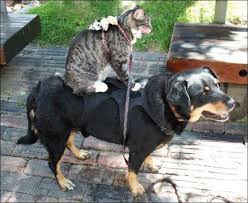
Dogs and cats are supposedly life-long enemies. Hence the phrase, "fighting like cats and dogs." Having always owned both cats and dogs, I find the phrase and the premise to be far more inaccurate than accurate. Of course, we all know that there are those dogs that will simply chase every cat they see and those cats that will never tolerate a dog. However, it has been my experience that handled correctly, the vast majority of dogs and cats can live together. They may not learn to love each other; but they certainly can learn to tolerate each other's presence. Dogs and cats that are raised with each other typically do fine their entire lives. They may actually accept an animal of another species more easily than one of their own, in that there are fewer fights over dominance and territory.

There are some dogs that should not be kept with cats. Dogs with a strong hunting heritage may always view cats as prey and may never be able to be trusted with any small animals. In addition to hunting dogs, terriers such as Jack Russells and pitbulls are often poor companions for cats. These dogs have an incredibly strong predatory instinct; they chase and attack moving objects without thinking about whom or what the object may be. Cats and other small pets are just too much of a temptation for these dogs.
Other dogs respond less to the animal than the situation and will leave alone a cat that sits still, but chase and attack one that moves. This is especially true of dogs that are kept outside. There is something about being out of the house that really pushes the hunting instinct into overdrive and will often result in even the most docile indoor dog attempting to chase cats once outside. So, one would not want to make the assumption that a cat and dog who tolerate each other indoors will do the same outside. The dog may decide to attack the cat. Finally, dogs that have a history of attacking cats are likely to do so again and should not be trusted with cats. If you are planning on rescuing a previously-owned dog, it is a good idea to get a history of the dog's attitudes and behaviors around cats before bringing it into a house with cats. Many shelters will allow you to 'test' the dog by introducing it to a cat before completing the adoption.
Most cats, if they have had positive experiences with dogs, will tolerate canines in the house. Those that will not typically have had some prior negative interaction that is firmly embedded in their memories. Because most cats, even those that hate dogs, do not attack without provocation, these cats may be able to live with a dog. However, they probably will never bond with the dog, will avoid the dog at all costs, and will be pretty miserable. It is kinder to leave these cats in a feline-only household. Again, it is often possible to find out the history of a cat before adopting it, or to test the cat's reactions to dogs in an adoption situation.
So which cats and dog can get along? The answer is just about all of the rest of them. In the best of circumstances, cats and dogs really become friends, playing and sleeping together. In other situations, cats and dogs may never be overly friendly, but they can learn to tolerate and behave themselves with other members of the family, including those of other species. As long as you are willing to work out a positive introduction and protect the animals from physical harm, these species usually get along. The process may take up to six or eight weeks, or even longer, but can be successfully accomplished.
If you are thinking of bringing a cat into a dog household, or vice-versa, there are steps that you can take to ensure the success of the relationship. First, because a dog can kill a cat, safety is your first concern. The dog needs to be able to be kept separated from the cat. This can be accomplished with a crate, or a separate room. The dog should have a refresher obedience course, so that it will sit, stay, and come to you when told, and leave the cat alone if ordered to. The dog needs to remember that the people, not the dog, rule the house. This way you can 'explain' to the dog, if necessary, that the cat is yours and needs to be treated with respect. In addition, the cat needs to have a safe haven. This means that the cat's food and litter boxes need to be inaccessible to the dog and that the cat has places to run and hide. For example, leave a few bookcase shelves empty so the cat can climb to them, put a cat door into a closed bedroom, or use baby gates to separate the dog from the cat's own room.
I keep my cats' litter boxes, toys, scratching posts, water, and food in an extra bedroom. I use a baby gate to keep the dogs out of the room. I have cut a small cat-size opening into the closed mesh of the gate so that the cats can dash through it if necessary and not have to leap the gate. My dogs respect the gate, but if you have dogs that leap over it, you may need to cut the cat door into the room door or install a screen door with an opening large enough for the cats.
The initial meeting and first few weeks are critical times to set the tone for the future, so it is important to make all introductions go as smoothly as possible. The key is to remember that these animals will be together for a lifetime; there is no reason to rush their meetings. If bringing a cat into the house, provide the cat with its own bedroom for the first few weeks or longer. The litter box and food should be placed in this room. The dog in the house can smell the cat under the door, but has no real need to meet the new member of the family until the cat is comfortable and bored with its personal space. If this is a young kitten, they may end up living in this room for several more weeks. Once the cat is doing well in its own room, you can let the cat explore the house, undisturbed by the dog. You can actually put the dog in the cat's room while the cat is out, so that the dog really gets to experience the cat's scent without bothering the cat. You can also get the pets used to each other's scents by swapping toys, towels, or other items between them.
The initial face to face meeting should be done after the new cat is familiar with the entire house. Make sure that the dog is on a leash and under control. Have another person near the cat to provide help, if needed. Keep the meeting short and positive. Praise the dog for being wonderful around the cat. Use food rewards if appropriate and make sure that the dog understands that good things happen when the cat is present. After a few, short positive meetings, it is time to let the cat explore for longer periods, with the dog present and on the leash. If this step proceeds calmly, let the dog off the leash and watch the interactions. Make sure you are always there to stop any problems before they can accelerate. Do not allow the dog to be aggressive in any way to the cat, and lavishly praise the dog for good behavior. Be certain that the cat has access to hiding places. If aggression occurs at any stage of the introductions, return to the previous stage and slow down. Even if all looks great, do not leave the cat alone with the dog until you are truly positive that everything is running smoothly. This means that if they cannot be supervised, the cat should be left in its bedroom or the dog kept crated.
Bringing a dog into a cat household is relatively easy. The dog should be kept on a leash for the initial introductions and never left unsupervised. Make sure that all animals are praised for their wonderful behavior when they are together. As previously discussed, the dog can be crated or the cat left in a bedroom when they cannot be watched. Since the cat is already familiar with its territory and the dog is a newcomer, the dynamics of the relationship often turn in the cat's favor, making the transition relatively easy.
Puppies and kittens do present unique challenges. Kittens must be protected from dogs at all times simply because any dog is big enough to badly hurt or kill a young kitten. A kitten must always be closely supervised even around the best behaved of dogs. Provide the kitten with appropriate toys of its own. Do not let the kitten 'play attack' the dog or chase it. This can rapidly escalate into a dangerous situation. For the same reason, do not let the dog 'play' with the kitten. The kitten must be kept in a safe room when an adult it not home. My kittens stayed in their own room when I was not at home and at bedtime until they were approximately six months old.
Rambunctious puppies may also be a problem. Without meaning to, an energetic puppy can harm a kitten or even an adult cat. It is up to you to make sure that their interactions are monitored so that no one gets hurt. It is also really important to exercise and play with the puppy routinely. Make sure the puppy has its own toys and uses them. A tired puppy is less likely to bother the cat and less likely to be a behavior problem in the house.
It takes work, patience, and time to introduce cats and dogs to each other. However, the positive outcome is well worth the work. My cats and dogs play, eat, relax, and sleep together. I get tremendous pleasure watching them. You will be pleasantly surprised how much positive energy is brought into your home by having both cats and dogs living there.
About the Author:
Pet Supplies Delivered / Omaha Vaccine Company is the pioneer and benchmark for the animal health mail order profession. For over 40 years, hundreds of thousands of loyal customers have relied on Omaha Vaccine Company for their animal health needs. For more information visit http://www.omahavaccine.com. Customer Service is also available by calling (800) 367-4444.

games for cats


4 Exciting Cat Games That You Can Enjoy With Your Feline Friend

Most of us know that cats are frisky pets. They may rest a lot, but at the same time, they also require lots of fun and play. Playing with your cat is an excellent way to build up the bond between your pet and yourself and also provides a form of exercise for your kitty. So, after you buy a cat, try to get it engaged in various games. Some common cat games include paw hockey, staircase dash, chase the bubbles and chase the string. It is easy to play with cats as they usually play with anything. Just remember that dangerous items like plastic packets, small toys or toy parts and toxic items should be kept away from your feline friend.


In this article, we give you an idea of 4 exciting cat games that you can enjoy with your furry friend.
Paw hockey: This game needs at least 10 square feet of free space. In that space, use a scrunched up aluminum sheet as a hockey puck for the cat to chase it across the floor.
Staircase dash: Place your cat at the top of a staircase while you stand at the bottom. Flick a table tennis ball near her and allow your kitty to chase it while the ball bounces down the stairs. Keep repeating the game till your cat gets too tired to chase the ball
Chase the bubble: Chasing bubbles is an enjoyable game that most cats enjoy. But for this game to be truly enjoyable, you should ideally play on a warm breezy day when the bubbles can be easily blown around. You can either use bubble solutions used for children or make your own using dishwashing liquid, glycerine, water and sugar. Blow the bubbles all around the room for your pet to chase.
Chase the string: String games are a perennial favorite of cats. Tie a ball or rubber mouse at the end of a thick string and drag it behind you as you race around the house. Watch your kitty amuse herself as she chases the object on the string.
Interactive forms of cat games allow your cat to sharpen her hunting skills, become more agile and sensitive to the surroundings. It is a healthy outlet for aggression and pent up energy, which is a common feline behavior. Since cats are shy or introverted by nature, they benefit a lot from these games as it helps them gain confidence.
Cat Condos and Outdoor Cat Enclosures are a great way to treat your cat. Visit our website today and sign up for your 7-part Healing Your Pets At Home mini-course absolutely free for a limited time only!

cat games


Cat Games - Games For You and Your Cat

Cat games provide your cat with the much needed exercise plus this is an effective way to bond and build trust with your furry pet. Aside from that this activity stimulates the mind of cats and your mind as well.


Care and attention given to dogs and cats differ. You can walk your dogs, or ask one to get your slipper or the morning paper and this can serve as exercise depending on dog breed. These you don't do to your cat, hence cat games.
Cats stay most of the time indoors and eat and sleep all day long. Cat games will help control their weight and also develop muscle tone, agility, and stamina.
Kittens are playful and they love to stalk, pounce, and wrestle. As a furry pet owner, you have the responsibility of supporting their playfulness by setting aside time to play with them.
Here is a list of five highly amusing cat games that you or your children can play with your cat for those rainy days and days when you simply can't find anything to do.
1) If your room is dim use a flashlight or better yet a laser pointer to flash a narrow beam of light on your furniture, walls, and floors. It would surely amuse you to see your cat chasing the light across the room and over furniture.
Be sure that you hide the source of light in your hand pretty well. They are smart creatures, once they find out what you're doing they'll get pretty bored.
2) It doesn't matter if you're doing all the hiding all the time, playing hide and seek with your cat is still fun both for your feline pet and you. To do this, bait your cat with something that he really loves i.e. their favorite food, next get your cat's attention, then try to hide.
3) Watch what happens when you crumple a piece of paper and roll it across the floor. Cats really love this game and will sometimes bring back the crumpled ball to you.
4) Get a piece string and attach any cat toy such as a fake mice, to it then move it across the floor until you get your cat's attention. Once this happens, you can run around the house pulling that string with you.
Once in a while allow your cat to 'catch' the fake mice to keep it from becoming bored. See your cat have a good time and hear yourself panting, this is good exercise for you both.
5) If you let your cats sleep with you, hide your fingers under the blanket and wiggle it. It would certainly be amusing to watch your furry pet try to pounce on what's under the blanket.
You can think out of the box and invent other games what's important is that you vary the cat games that you do because cats get bored very easily. To determine whether your furry friend is having fun look at their eyes, if they are dilated then they are happy.
In the course of playing games with your cat they might accidentally swallow their toy or fall off the stairs. The cost of medically treating your cat can be expensive but with Discount Pet Insurance you will have no worries. Mature pets can still be covered find out how at Older Pet Insurance

cat games


Cat Games to Amuse Your Kitty

Cat games are a great way to spend some quality time with your kitty. Cats love to pretend they are fighting during play. This play fighting is nature's way of teaching a young kitten to take care itself. Play is associated with hunting and they enjoy toys that look like little animals. A hungry cat seems to enjoy play even more. A cat hardly distinguishes between hunting, play, and eating.


Here are some fun cat games to entertain your kitty. Go to a local office supply store and purchase a laser pointer. Put your cat in a dimly lit room and shine the red dot near him. The movement of the red dot will get his attention and he will give chase. Another of the fun cats games is to get an old toilet paper roll and let him bat this around. As he tires of this try adding an object such a small ball inside the paper roll and tape the ends shut. The ball will cause a more lively motion to the paper roll and the fun will begin again.
As you know the sight of feathers excites cats. Anyone who has watched his cat sit in a window and watch the birds knows this. You can easily make one of these feather cat games at home. Simply sew two identical pieces of cloth together. Leave a small opening in one end to accommodate the feathers. Put some cotton and catnip inside to fill the toy. Insert the feathers into the opening and sew it closed. A little glue around the feathers will hold them in. Show him his new toy and give it a toss. You can also tie a string to the toy and pull it along the floor. Let him catch his "birdie" once in while so he does not get bored.
A ping-pong ball is another of the fun games. The ping-pong ball has an energetic bounce that will get his attention. What is even more fun is to play with ball in a small room. Bouncing the ball off the walls will add even more fun.
Do not let your cat play by himself with anything that could harm him. Even a string could be a choking hazard.
You might also be interested in equestrian horse jumping.

Monday, December 26, 2011

feral cats


Feral Cat

What is a feral cat? It is an untamed cat born in the wild. A stray cat is not necessarily a feral cat. This cat grows up with no human contact unlike a stray cat who can have human contact but is not owned by someone.


In the United States, a feral cat commonly comes from an abandoned domestic cat's offspring. Owners who have not spayed or neutered a cat may lose or abandon it. Although the parent(s) have had human contact, the offspring will not inherit this exposure. Even the parent(s) in time may revert back to being a wild cat.
In Australia, a feral cat is a breed that lives in the wild. These cats can be found throughout the country. They are predators to marsupials, reptiles and birds. Australia, New Zealand and several island countries have had problems with large populations of feral cats destroying different species of wildlife. Some countries tried eliminating them but that led to other animal control problems.
These cats are usually found in groups. Their lifespan is much shorter than a domestic cat because they are prey for larger animals. They can be found in areas of extreme heat or cold. They play a part in controlling the small animal population especially rodents. Unfortunately, they also feed on birds.
Controlling this population has always been a challenge. Some states allow them to be hunted and killed. Another technique is to trap, neuter and release the cat. This has been effective but very time consuming. The Feral Cat Coalition in San Diego has a program at no cost to help control this population. Recently seven feral cats were trapped on Saint Nicolas Island in California. Instead of being exterminated, the cats were transferred to an the Animal Medical Center in El Cajon. The Humane Society of the United States, the United States Fish and Wildlife Service and the U.S. Navy are working together to try to control this population on the island of over 200 of these cats.
A feral cat can be tamed to live with humans but this is recommended at the young kitten stage. A slow process of 2 to 6 weeks is required to acclimate a feral kitten to humans. Having a adult domestic cat can act as a role model for the kitten. Taming an adult can be done but requires a different approach. Some feral cats or kittens cannot be tamed based on their temperament. If a cat that cannot be tamed is returned to the wild, it should be spayed or neutered.
A feral cat is a wild animal. It can carry diseases including rabies. A cat is a prime carrier of a parasite called toxoplasmosis. This parasite can be very dangerous to humans with weakened humane systems. A feral cat because it feeds on raw meat is more apt to have the parasite. If you find one, be very careful and seek professional help on how to handle it. If bitten by a feral cat, see a doctor immediately.
My name is Frank Loethen. If you enjoyed reading this article, please visit my cat products website, http://purrfectcatproducts.com/ Available are high quality cat products at great prices.

cat names


10 Cat Names and Their Meanings

Some people may wonder if there is any point in taking the time to name a cat. It's well-known that calling them by that name is no guarantee that they are going to come to you. Offering admonishments of "No, Fluffy!" is going to, more often than not, bring the exact same results as if you'd said nothing at all.


While cats certainly have a mind of their own and are not prone to being even the least bit obedient, the name is still an important part of the ritual of owning a cat. Even if naming a cat (and later using that name) is an exercise in futility, we still want to get it right.
Here are 10 cat names along with their meanings to help you get started in the search for the perfect name for your four-legged feline friend.
  • Tigger
Meaning: Winnie the Pooh's bouncing friend
This is among the most popular names for cats, especially if the cat happens to have tiger like stripes. Not very original, but if you ask your child to help name the cat, this is very likely to be among the suggestions.
  • Emu
Meaning: Egyptian word for "cat"
You probably don't hear about a lot of cats named Emu, but if you're looking for a name that is different and that can be a bit of a conversation starter, this might be the one.
  • Lucy
Meaning: Learning, light
This name is popular for both cats and dogs, but just seems to fit some cats very well. This is a particularly appropriate name for a cat that tends to be funny as it pays homage to one of the greatest comediennes of all time.
  • Maggie
Meaning: A pearl
Not only is this once popular name making a comeback in the feline world, but more and more people are naming their human babies Maggie as well.
  • Zoe
Meaning: Life
Another name that is popular for humans as well as animals, Zoe is perfect for your laid back female cat.
  • Lalla
Meaning: Abbreviation of a name that means well-spoken
Have a very vocal cat? This name would be a cute nod to her penchant for verbalizing. As a bonus, it's kind of fun to say.
  • Paco
Meaning: Free
This is the perfect name if you got your cat by answering a "free to a good home ad".
  • Sage
Meaning: Wise one
This name gives your cat the credit she THINKS she deserves. It does seem that most cats think they are smarter than people. Might as well give them a name that reflects that.
  • Tabitha
Meaning: Biblical character noted for her good works
This name was very popular during the 60's and 70's when the show Bewitched featured a character by that name. It is debatable whether this name is appropriate for cats since most are not known for their good works.
  • Waqi
Meaning: Falling
The name means falling, but sounds like "wacky". Seems like a perfect name for a cat!
Even though you know he or she won't come when you say it, naming your cat can still be fun. Don't look at it like an exercise in futility, consider your way of giving your cat the gift of something very specific to ignore.
Neil Lemons is a pet lover and Online Journalist. He has had the privilege of owning several cats and dogs over the years, some living into their 90s (in dog years). For information on where you can buy homemade flavored cat treats, check out http://www.N-Bone.com, world authority on healthy animal treats for your dog, cat, or ferret.

bengal cats


Bengal Cats

Bengal cats are a new breed, cross-bred with a wildcat. Their spotted or marbled coat is soft and thick, they have a large, sleek muscular build, rounded slighted long face, oval eyes and thick tail. They have an enviable, exotic appearance without the wild temperament of their much larger untamed ancestors.


Characteristics
Bengal came from the taxonomic name of the Asian Leopard Cats (ALC) and not from the more widely known Bengal Tiger species, which is unrelated to the Bengal Cats ancestry. These cats have a series of horizontal stripes on their faces, known as mascara, which extend along the eye to the back of the neck. Their back and sides are marked with spots like those of a jaguar, and the rest of the body, legs and tail, are marked with symmetrical stripes. The spots sometimes have a marbled appearance and are generally made up of two colors. The following colors and patterns are recognized as Bengal Cats and therefore eligible for competition; Brown Spotted Tabby, Brown Marbled Tabby, Seal Mink Spotted Tabby, Seal Mink Marbled Tabby, Seal Sepia Spotted Tabby, Seal Sepia Marbled Tabby, Seal Spotted Lynx Point, and Seal Marbled Lynx Point. These pets are the only variety that sometimes have a pearl or gold dusting, sometimes called glitter, and the texture of their fur is rich and silky-smooth. Bengal Cats even have a different sound in their voice and tend to be very vocal.
Temperament
Originally some of the Bengal Cats inherited the unpredictable temperament of the wildcat, but breeding programs concentrated on breeding a gentler nature. The domestic feline is very lively and active, but also quite self-contained and quiet.
Brief History
As the story goes, Jean Sugden Mills, around 1982 bred a domestic cat with a feral Indian Mau. At about the same time, Greg and Elizabeth Kent started their own breed of Bengal Cats using an Egyptian Mau. Both Jean Mills the Kents worked hard to popularize the this breed, and in 1986, The International Cat Association adopted the first written breed standard. Today Bengal Cats are the most popular registered cat breed.
Care and grooming of Bengal Cats ought to be kept up as any other housecat; frequent combing of fur, good nutrition, regular play and veterinary visits. For more information on the care and feeding of our favorite furry pets, visit: [http://lovefatcats.com]

facts about cats


Interesting Facts About Cats!

Did you know?
All cats are born blind. The ability to see comes during the first couple of weeks after birth!
Cats have rudimentary nonfunctional collar bones that allow them to squeeze themselves through tight spaces and helps them in their balance and stride!


Cats often have a third eyelid that is not normally visible to us. If you are seeing it more often - the cat may be ill!
Cat vision is similar to humans in daylight, but they can see six times better than us in dim light - owing to larger pupils and the ability to gather light at the back of the eye owing to a reflective retinal surface!
Field of vision in cats is slightly compromised for a more binocular vision, that grants them greater depth perception and ability to judge their prey's position more precisely for pouncing upon them in high speed pursuits!
Cats' sense of smell is fourteen times stronger than ours - this means they can smell the odour in the litter box much earlier than us!
Cats' hearing is also very good. They are able to hear sounds of higher pitch than us and dogs. Thirty two individual muscles in their ears allow them to pinpoint the exact location of a source of sound!
The individual positioning of whiskers is unique to all cats - they are like finger prints. Whiskers also allow cats to feel their way in extreme dark and since their span, when fully erect, is nearly equal to cats' body width - it allows cats to judge whether a space or passage is too narrow for them! Whiskers also are usually indicative of cat behavior. Erect, forward pointing whiskers indicate that the cat is excited, animated. Whereas laid back whiskers are often seen in resting, defensive conditions!
Cats have sharp pointed teeth that are built for killing prey by suffocation/severing of spine. A cat's teeth are its greatest asset in the wild. In proportion to body size, the elusive Clouded Leopard has the longest canines in the family felidae, whereas the Jaguar has the strongest jaws - I have seen it bite through the shell of turtles in documentaries!
Cats have more spines than us since they also have spines in their tail. Next time you see a kid pulling a cat's tail - stop him - since it hurts. Their vertebrae are also more loosely connected to each other than ours, allowing them great flexibility!
Flexibility of the spine is highlighted in the Cheetah - the fastest land mammals. With big adrenals, flexible spine and a rudder-like tail, Cheetah can out pace everything on African savanna!
Tiger is the largest feline on earth. An adult Siberian tiger may weigh up to eight hundred pounds and is one of the top predators on earth. Tigers are excellent swimmers and are in fact the only cat who seem to enjoy stepping in water (the Jaguar in Americas frequently go into water to hunt baby alligators and anacondas)!
Lion is the only cat that lives in groups, called prides. The only social cat, family life gives lions edge over other felids by virtue of their cooperative hunting!
Leopards are highly secretive and are perhaps the best tree climbers and individual hunters amongst big cats. Black leopards are called panthers!
The author is a blogger about cats and an expert on interesting cat facts
Learn more about cats by visiting: http://www.ofcats.com

himalayan cats


Himalayan Cat

Himalayan is a breed of long-haired felines. It is a very popular and pretty cat. The cat originated in 1930 in United States through breeding of Persian and Siamese cats. The objective was to create a breed with the long hair of the Persian and the points of the Siamese. Indeed it is referred to today in European countries as the Colorpoint Persian.


The Himalayan is light colored at birth. With time markings develop on face, limbs, ears and tail. This is attributed at times to difference in temperature between the trunk and extremities. Accepted colors include blue, brown, chocolate, cream, flame, lilac and red. Fur is long, flowing and often thick. Overall built of the cat is stocky with short limbs and large round paws. Head is round and somewhat big and supported by a short neck. Ears are small, though eyes are big, bright and round, in varying shades of blue.
Owing to their extremely long fur, these Colorpoint Persians are subject to periodic development of matts and hairballs, requiring regular grooming and baths. Their depressed nose obstructs their breathing at times and compresses the tear ducts, leading to permanently watery eyes in some cases. As such, the Himalayans often require their face to be wiped as the coat is brushed daily. Furthermore decades of inbreeding to create the prefect Himalayan has meant that these pretty felines sometimes suffer from genetic defects, resulting in organ failures, in particular Polycystic Kidney Disease.
As regards temperament, the Himalayans are quite peaceful and at times laid back. They are loving and interested in their owners and develop close bonds with them. Social and gentle cats, the Himalayans make adoring companions. Even as their company requires daily grooming and maintenance, pet owners around the world recognize that it is well worth the effort and cherish the company of these lovely cats.
The author is a blogger about cats and an expert on Himalayan cats.

Sunday, December 25, 2011

hypoallergenic cats


Hypoallergenic Cat

If ones nose starts running, eyes water, throat feels like it is closing or hives develop when a cat is near, an allergy to it is the problem. Immunotherapy, a series of injections is one solution. Another is purchasing a hypoallergenic cat.


Allerca Lifestyle Pets sells hypoallergenic kittens for $5,950. The kitten is a short haired breed based on the British Shorthair. Although not guaranteed, the sex and coat color and pattern are optional. Currently, there is a two year wait but for an additional $1950, the waiting time can be reduced. Allerca offers a one year full refund guarantee.
Allergic reaction to a cat is caused by Fel d 1 glycoprotein which is secreted by the skin and saliva. In worst cases, it can cause asthma in allergy sufferers. Every time a it licks or rubs against something, Fel d 1 is deposited. The allergen builds up quickly existing every where it has been.
How does Allerca create a hypoallergenic cat? The company uses a form of selective breeding. It isolated the gene that produced Fel d 1 and accelerated the genetic divergence process thus minimizing or eliminating the gene. This did not cause any genetic problems with the animal.
There are some breeds that can lessen an allergic reaction. Different breeds have different levels of Fel d 1. Devon and Cornish Rex have a reduced number of hairs leaving less surface area to collect allergens. The Shpynx is almost completely hairless. The Russian Blue has a low level of this allergen. The Siberian has the least amount of this allergen of all breeds. Females have less of this allergen then males. Un-neutered males have more than neutered males.
Some of the ways to minimize the amount of allergens:
Spay or neuter.
Wash it periodically in plain water.
Flea control.
Install an air filtration system.
Ventilate the house.
Vacuum carpets with HEPA equipped vacuum cleaner.
Avoid wearing wool which attracts allergens.
Keep the litter box in a well ventilated area.
Use an enclosure to keep it outside sometimes.
The best way to treat this allergy is not to have a cat. Other alternatives are to suffer with the allergy and use over the counter medications to treat it. Get a series of injections to reduce the allergic symptoms. Contact Allerca and purchase a hypoallergenic cat.
Frank Loethen lives with his wife and three cats, Sunny, Sinclair and Midnite, in Georgia. If you enjoyed this article, please visit my cat products website, http://www.purrfectcatproducts.com, your one stop site for all your cat and kitten needs. Cat food, cat toys, litter accessories and cat treats are among the many items on the site. You can also see my three cats on the site.

kittens


How to Raise a Healthy Kitten

Selecting a Kitten
It is best to choose your kitten from the whole litter, choose the frisky playful, friendly kitten that is confident and happy to approach you rather than the one that hangs back and is shy. The best time to take your kitten home is between 7 and 8 weeks old. Some pedigree breeders like to keep the kittens until 12 weeks old so they can have their initial vaccinations.


Some things you have to look for when choosing a new kitten or cat are:
  • The ears should be clean and no unpleasant smells.

  • White blue eyed cats are prone to deafness (all cats eyes are blue at this age) Test this by making sounds outside its field of vision.

  • Eyes should be clear and bright with no sings of weeping.

  • Gums should be pink (not red) and teeth should be white.

  • The coat should be clean and unmated with no fleas or flaky skin.

  • Check under the tail - this area should be spotless in a healthy cat.
  • Setting in your new Kitten or cat
    It is probably best to have a proper pet carrier to take your new pet home in - to avoid extra stress. At let your new kitten
    or cat come out of the carrier at its own time. It will need time to settle down, so make sure it has fresh drinking water and a little food also make sure it can find its way to its bed and litter tray - then leave it alone for a little while. Make sure that children behave gently and quietly around the kitten, kittens need peace and quiet to sleep as well as needing laytime. It is best to keep your kitten confined indoors for a week or so and accompany your kitten on its first trip outside - continue to go out side with your kitten for the next few trips. This will give the kitten a sense of security and encourage it to come when you call. Your new kitten should integrate quite well with other pets, make sure that you can introduce them slowly. Some pets will integrate at all - make sure you keep small mammals and birds away from your kitten as their natural instincts will take over. Once your kitten has overcome its initial fears it will amuse it self for hours with very cheap simple toys like ping pong balls, cardboard rolls and small stuffed animals.
    What Equipment your cat or kitten need
    A bed: a cardboard box with a blanket or cushion in it - makes an ideal bed for a kitten as the kitten grows you may like to find a more permanent replacement, such as wooden box or a covered bed. You may like to keep in mind that it should ideally be washable when choosing a bed. Place the bed in a quiet, draught free, warm spot.
    Grooming tools: - A brush - preferably with natural bristles is very useful for grooming any cat - for long haired cats you will also need a wire toothed metal comb and a pair of rounded scissors to cut out any tangles. A pair of feline claw clippers will complete your pussy cats grooming set.
    A collar or harness: Your cat should wear a collar complete with an identification disk. The collar must be elasticized in case it gets caught - for example on a branch whilst climbing a tree. Some owners train their cats to go for walks on a harness or lead.
    Toys: There are a huge range of toys available for cats making play of exercising fun and providing stimulation. Many stuffed toys contain catnip - this herb also called catmint appeals to many cats, creating an apparent sense of wellbeing - this lasts for approximately 15 minutes.
    A scratching post
    - Cats love to scratch. Scratching serves a couple of purposes - firstly it keeps the claws neat and trim - it also marks the cats' territory as other cats will see the marks and smell the scent. The cat has glands between the toes that release this scent as the cat scratches.

    A scratching post is the best solution - but the cat will need to be taught to use it from the very beginning. This will save your furniture, avoid using a carpet covered scratching post as the pet cat may see the house carpet as an extension of the scratching post. If the cat ha selected a piece of furniture where it like to scratch - by covering it with plastic for a while the cat will stop scratching there. Cats do not like the feel of plastic.
    A litter tray
    - A litter tray will be needed when your kitten first comes home and if you intend to leave the cat in at night. Choose a tray
    that is deep enough and roomy enough for your cat to turn around in easily. There are numerous varieties of kitty litter available - choose one that suits you. Also a covered litter tray is a great idea as it keeps the smell and the mess inside also creating a more private spot for your cat.
    A Cat flap
    - Cat flaps are a great idea to allow the cat to go in and out as it pleases. You must be careful however as other cats may also come in. check what flaps are available and choose the one that suits your needs. A cat is quite easily trained to use a cat flap - prop the flap open at first and call the cat through form one side than the other. When it has mastered this, lower the flap a little and use the same procedure - continue to do this until you can close the flap altogether.
    Feeding your kitten
    Ask the breeder or pet shop for a diet sheet so that you can continue feeding them the same diet and quantities. This will avoid you giving it too much food or an over rich diet which can cause tummy upsets. You should also find out meal times.
    Food and feeding your cat
    There are three types of cat food available commercially -moist food, semi - moist food and dry food. Cats need meat or fish everyday to be healthy.
  • Moist food as in the canned varieties is preferred by most cats because it closely resembles fresh meat. It also has the
    vitamins and minerals that the cat needs. How ever canned foods will not last long once served and it is best to take the food away after an hour to encourage your cat to eat its food in a single sitting rather that picking at it all day long.

  • Semi - moist food usually comes in a sachet. It keeps well in a bowl without drying out or loosing its texture and tastes good to cats.

  • Dry food contains very little moisture so it is very important to have fresh drinking water available.
  • Establish a feeding routine where you feed your cat once or twice a day - at the same place and the same time. Leave the food out for an hour then take it away. This will help to make your cat a healthy eater and not pick at the food all day.
    Worming
  • The most common worms that affect cats are round worms and tape worms. Cats must be de-wormed regularly. Your vet will give you specific advice on worming products.
  • Following these simple steps will ensure you, your family and the newest edition to the family will have a happy, healthy and rewarding time together.
    (c) Katharine Logan 2005
    http://www.pet-library.com
    Katharine Logan is author and content manager for Pet-library.com She conducts research on specified subjects to help people with day to day issues. For more click on:[http://www.pet-library.com]