INFL

Showing posts with label insects. Show all posts

Thursday, July 24, 2014

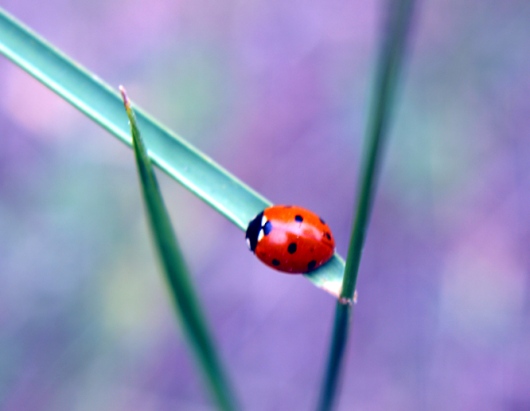
Ladybug


Ladybug

Coccinellidae
Photo: Ladybug on cholla cactus
Ladybugs, ladybirds, or lady beetles—whatever one calls them—are favored by farmers as voracious pest-eaters.
Photograph by Raul Touzon
Many people are fond of ladybugs because of their colorful, spotted appearance. But farmers love them for their appetite. Most ladybugs voraciously consume plant-eating insects, such as aphids, and in doing so they help to protect crops. Ladybugs lay hundreds of eggs in the colonies of aphids and other plant-eating pests. When they hatch, the ladybug larvae immediately begin to feed.
Ladybugs are also called lady beetles or, in Europe, ladybird beetles. There are about 5,000 different species of these insects, and not all of them have the same appetites. A few ladybugs prey not on plant-eaters but on plants. The Mexican bean beetle and the squash beetle are destructive pests that prey upon the crops mentioned in their names.
Ladybugs appear as half-spheres, tiny, spotted, round or oval-shaped domes. They have short legs and antennae.
Read full here...http://animals.nationalgeographic.com/animals/bugs/ladybug/

Saturday, March 22, 2014

Hornet

Hornet 

Vespidae
Photo: Close-up of a hornet on a plant
Hornets eat leaves and tree sap but are also accomplished predators, feeding on flies, bees, and other insects.
Photograph by H.L. Fox/Animals Animals
Hornets are wasps of the genusVespa, closely related to (and resembling) yellowjackets. There are about 20 hornet species. Most live in tropical Asia, but the insects are also found in Europe, Africa, and North America, where the European hornet was introduced by humans.
These social insects construct hives by chewing wood into a papery construction pulp. They mature from egg to adult inside the community hive.
Queens dominate hornet hives and are the only females to reproduce. Most other hornets are asexual female workers that perform essential community duties such as building the hive, gathering food, feeding the young, and protecting the colony. Males are few and they have only one real role—mating with the queen. Males typically die soon after their sexual task is complete.
In colder climes, hornet nests are abandoned in winter and only new, young queens (and their eggs) survive the season by finding protected areas under tree bark or even inside human dwellings. In the spring, such a queen will begin a new nest, and soon her young will become workers and take over the chores of the new hive—leaving the queen to tend to reproduction. She will produce more workers to expand the hive and then, before she dies, yield a breeding generation of new queens and males (drones) to restart the cycle of life.
These insects eat some tree sap but they are also accomplished predators. A hornet hive will eliminate many flies, bees, and other insects.
Workers defend their hive with potent stingers. Though these insects do not sting humans unless provoked, some people are allergic to their venom and can have very dangerous reactions to a sting.
Read full here... http://animals.nationalgeographic.com/animals/bugs/hornet/#close-modal

Tuesday, July 17, 2012

Spider Venom Could Treat Muscular Dystrophy


Protein Found in Spider Venom Could Treat Muscular Dystrophy

ScienceDaily (July 16, 2012) — While Spider-Man is capturing the imagination of theatergoers, real-life spider men in Upstate New York are working intently to save a young boy's life.

UB researchers are developing a treatment for muscular dystrophy using a peptide found in the venom of a Chilean rose tarantula. (Credit: Image courtesy of University at Buffalo)
It all began in 2009, when Jeff Harvey, a stockbroker from the Buffalo suburbs, discovered that his grandson, JB, had Duchenne muscular dystrophy. The disease is fatal. It strikes only boys, causing their muscles to waste away.
Hoping to help his grandson, Harvey searched Google for promising muscular dystrophy treatments and, in a moment of serendipity, stumbled upon University at Buffalo scientist Frederick Sachs, PhD.
Sachs was a professor of physiology and biophysics who had been studying the medical benefits of venom. In the venom of the Chilean rose tarantula, he and his colleagues discovered a protein that held promise for keeping muscular dystrophy at bay. Specifically, the protein helped stop muscle cells from deteriorating.
Within months of getting in touch, Harvey and Sachs co-founded Tonus Therapeutics, a pharmaceutical company devoted to developing the protein as a drug. Though the treatment has yet to be tested in humans, it has helped dystrophic mice gain strength in preliminary experiments.
The therapy is not a cure. But if it works in humans, it could extend the lives of children like JB for years -- maybe even decades.
Success can't come quickly enough.
JB, now four, can't walk down the stairs alone. When he runs, he waddles. He receives physical therapy and takes steroids as a treatment. While playing tee ball one recent day, he confided to his grandfather, "When I grow up, I want to be a baseball player." It was a heartbreaking moment.
"Oh, I would be thrilled if you could be a baseball player," Harvey remembers replying. He's doing everything he can to make sure that JB -- and other boys like him -- can live out their dreams.
Story Source:
The above story is reprinted from materials provided byUniversity at Buffalo.
link: http://www.sciencedaily.com/releases/2012/07/120716142657.htm 

Tuesday, May 1, 2012

Ladybug


A nine-spotted ladybug, the official insect of New York State. It was spotted in the Long Island getaway town of Amagansett -- no small matter, since there had not been a confirmed sighting of one anywhere in New York in 29 years. (Jim Pisarowicz/National Park Service)


link: http://abcnews.go.com