INFL

Showing posts with label wild. Show all posts

Thursday, November 14, 2013

Wild Turkey

Wild Turkey

Meleagris gallopavo
Photo: A wild turkey
Wild turkeys, with their distinctive feathers and gobbling call, were Benjamin Franklin's choice for the national bird of the United States.
Photograph courtesy Gary M. Stolz/U.S. Fish and Wildlife Service
The turkey was Benjamin Franklin's choice for the United States's national bird. The noble fowl was a favored food of Native Americans. When Europeans arrived, they made it one of only two domestic birds native to the Americas—the Muscovy duck shares the distinction.
Yet by the early 20th century, wild turkeys no longer roamed over much of their traditional range. They had been wiped out by hunting and the disappearance of their favored woodland habitat.
Wild turkeys typically forage on forest floors, but can also be found in grasslands and swamps. They feed on nuts, seeds, fruits, insects, and salamanders.
Wild turkey reintroduction programs began in the 1940s, and the birds were relocated to areas where populations had been decimated but woodlands were recovering. Such efforts worked so well that wild turkeys now live in areas where they may not have occurred when Europeans first reached the Americas. Today, flocks are also found in Hawaii, Europe, and New Zealand.
Only male turkeys display the ruffled feathers, fanlike tail, bare head, and bright beard commonly associated with these birds. They also gobble with a distinctive sound that can be heard a mile (a kilometer and a half) away.
Females lay 4 to 17 eggs, and feed their chicks after they hatch—but only for a few days. Young turkeys quickly learn to fend for themselves as part of mother/child flocks that can include dozens of animals. Males take no role in the care of young turkeys.
Domestic turkeys have white-tipped tails because they are the descendants of a Mexican subspecies that was taken to Europe for domestication in the early 16th century. The feature distinguishes them from most modern wild turkeys, though captive diet, lifestyle, and breeding have caused other physical discrepancies.

Wednesday, July 18, 2012

Endangered wild horses


Endangered wild horses head to Mongolia

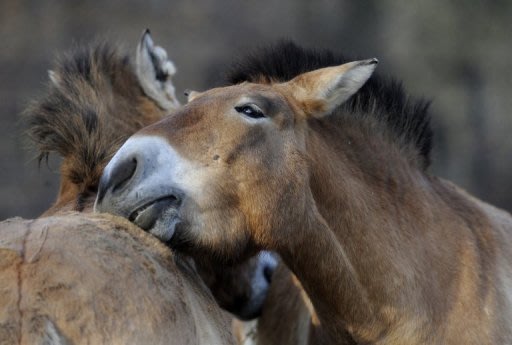
Four rare Przewalski's wild horses were headed for the Mongolian steppe from Prague on Monday as part of a project to reintroduce the critically endangered species to its ancient homeland.
Prague zoo runs a breeding programme and is charged with keeping the world genealogy book for the equines which have survived only in captivity since the last wild horse was seen in Mongolia in 1969.

Przewalski horses share a moment …

The four mares, aged three to five, will be flown 18 hours in wooden boxes to Bulgan, about 200 kilometres (125 miles) northwest of the Mongolian capital Ulan Bator.
"The mares are more nervous than last year," Prague zoo director Miroslav Bobek said, referring to another four horses sent to Mongolia in 2011.
From Bulgan, the horses will be taken by road to the Gobi B national protected park, where the population of the horses shrank to 49 from 150 during the severe winter of 2009-2010.
"They must be animals of an adequate age, with the correct genetic setup, in a good shape, and we also chose them by character to avoid taking mares susceptible to stress," Bobek said.
Two mares sent last year have already given birth in the steppe.
"We'd like to continue with the transports to Mongolia... where we're trying to create sustainable conditions for both the horses and the people who live close to them," said Bobek.
Characterised by thick necks, large heads and stocky girths, Przewalski's horses weigh between 250-350 kilograms (550-770 pounds) and stand about 1.2-1.3 metres (3.9-4.3 feet) tall at the withers.
With ancient cave paintings in Lascaux, France, featuring wild horses eerily resembling the Przewalski variety, the species is thought to have lived in Europe 20,000 years ago, but climate change chased the animals away to Asia.
Europeans only encountered the wild horses at the end of the 19th century when Russian explorer and geographer Nikolai Mikhailovich Przewalski discovered them in mountains bordering the Gobi desert.
In the 20th century, hunting brought Przewalski's horses to the verge of extinction.

Saturday, July 14, 2012

Wolverines need refrigerators


Study: Wolverines Need Refrigerators

ScienceDaily (July 12, 2012) — Wolverines live in harsh conditions; they range over large areas of cold mountainous low-productivity habitat with persistent snow. The paper suggests wolverines take advantage of the crevices and boulders of the mountainous terrain, as well as the snow cover to cache and "refrigerate" food sources such as elk, caribou, moose and mountain goat carrion, ground squirrels and other food collected during more plentiful times of year.

Wolverine. (Credit: Mark Packila, WCS)
These cold, structured chambers provide protection of the food supply from scavengers, insects and bacteria. In addition, the refrigerated caches increase the predictability of available food resources, reduce the energy spent by females searching for food while in lactation phase, and decrease the time mothers spend away from cubs.
The paper appears in the current edition of the Journal of Mammalogyand was co-authored by Robert M. Inman of WCS, Audrey J. Magoun of Wildlife Research and Management, Jens Persson of the Swedish University of Agricultural Sciences, and Jenny Mattisson of the Norwegian Institute for Nature Research.
"People don't normally think of insects and microbes as being in competition for food with wolverines," said lead author Robert Inman of the Wildlife Conservation Society's North America Program. "But in fact, bacteria will devour an unprotected food source if that source is available."
Through an extensive literary review, the authors noted that wolverine reproduction is confined to a brief period of the year, and the lactation phase in females (February through April) corresponds to a period of low availability of food resources. Wolverines, which are opportunistic foragers, have adapted by amassing food caches during the preceding winter months when food is more readily available. Without the cached food supply or an unforeseen alternative (such as a winter-killed ungulate), early litter loss occurs.
Inman said, "Understanding why and how wolverines exist where they do and the various adaptations they have evolved to eke out a living will better inform population management strategies and conservation of the species."
Climate change will play a key role in management planning for the conservation of wolverines, the authors say.
In a study published in 2010, wolverine biologists demonstrated a relationship between the areas where wolverines exist (their distribution) and persistent snow cover. The first theory advanced was that wolverines must have deep snow available in springtime so that they can give birth to their small cubs in a warm, secure den. The newly released study suggests that other factors related to climate and snow pack, such as competition for food, may also be involved in explaining the limits to wolverine distribution.
Because of their dependence on snow pack, wolverines were recently listed as warranted for protection under the Endangered Species Act due in large part to the threat of climate change reducing distribution and habitat connectivity. The authors say that a deeper understanding of how and why wolverines use snow pack the ways they do is critical to understanding how climate change will impact survival and reproductive rates. "Shedding light on the specific mechanism of how climate will affect wolverines is important in order to know what to do to help them hold on," said WCS's North America Program Director, Jodi Hilty.
Inman and co-authors published a study in December of 2011 on the spatial ecology of wolverines in the Journal of Wildlife Management. This latest paper represents the second of several that will help to inform a conservation strategy for the species.
Story Source:
The above story is reprinted from materials provided byWildlife Conservation Society, via Newswise.
Note: Materials may be edited for content and length. For further information, please contact the source cited above.

Journal Reference:
  1. Robert M. Inman, Audrey J. Magoun, Jens Persson, Jenny Mattisson. The wolverine's niche: linking reproductive chronology, caching, competition, and climateJournal of Mammalogy, 2012; 93 (3): 634 DOI: 10.1644/11-MAMM-A-319.1