INFL

Showing posts with label cat picture. Show all posts

Saturday, December 31, 2011

cat facts


Cat Facts

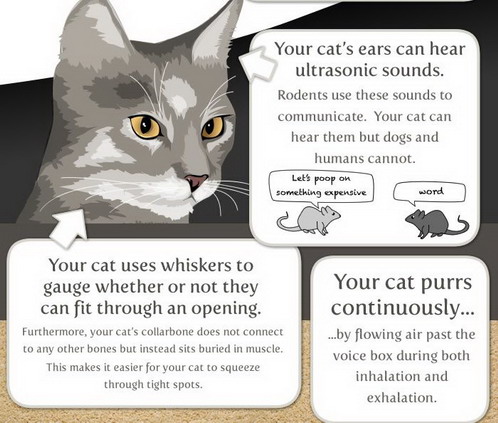
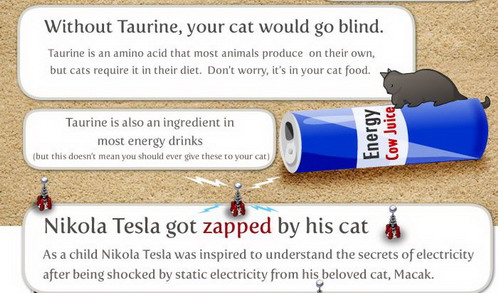
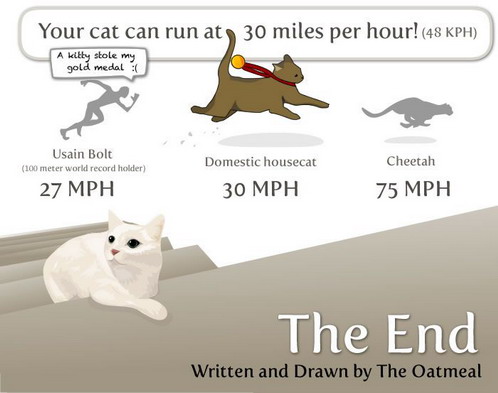
About 40 million years ago, the ancestors of today's cats were Miacis who lived in a tree. He was a great hunter. Smilodjon was his descendant, who was able to kill large animals because of the size of their teeth. Miacis were quickly spread throughout the world, except Australija. We can say that cat has been always present in the vicinity of man. Sometimes the cat was associated with the gods, sometimes was considered as men helper and sometimes was regarded as the enemy associated with witches and the devil.

Source: http://www.myrelaxplace.com/2009/11/26/seventeen-thing-about-cat-facts/


Despite of the crossings species and the custom of living with people, the cat has not lost their primal instincts.
Every part of her body developed primarily for hunting:
Sense of balance, length of tail, structure of the pelvis allows her to jump from a height of more than 20 yards on four paws, and remain almost unharmed.
Claws are a means for climbing.
If climbing is enjoyable entertainment, lowering carries some risk. Claws, although very useful for climbing, at the time of landing may be interference.
Before alighting from the trees, cat will carefully evaluate all the possibilities, especially distance from the ground, measuring it with the movement of the head from the top to the bottom. If the cat has no other option but to throw herself, she will try to extend the jump as much as possible in order to achieve the landing as horizontal she can. It makes landing easier.
In cases like that or in the case of vertical drop, flexible spine allows her to rotate the body spiraly and fall straight on the paws.

abyssinian cats


Cat Breed - Abyssinian

The Abyssinian cat is commonly believed to date back to the 1860s, originating in Ethiopia, yet some people claim that the breed can be traced back to the ancient cats of Abyssinia, now called Egypt.


It is one of the oldest known breeds, the first one being brought to England in 1868. The Abyssinian was officially recognized as a distinct breed in 1882.
They are known for their sharp intelligence, litheness and a refined, pleasant demeanor, often becoming very attached to their owners. Abyssinians are extroverted and willful with a curious and adventurous nature being the norm; they are active, playful and inquisitive!
This cat has a medium length body with well-developed muscles, and short, silky, fine, close-lying coats; their faces have round, almond-shaped eyes, green, hazel or amber in color. They have legs of moderate length; size-wise they tend to weigh between 4-7.5kg (9-16lb).
The tail is fairly long, broad at the base and tapering to a point. Abyssinian's have fine bone structures and their paws are small and oval-shaped.
The cat's ears are alert and relatively large, broad and cupped at the base; they have an M-shaped marking found in fur on the forehead.
The Abyssinian has a "ticked" coat, meaning that each hair, light in color, has several dark bands which are evenly spaced. This coloring results in an ideal camouflage for the dry desert lands of North Africa.
These days, the Abyssinian comes in a range of different colors. Anything from red through fawn, lilac, cinnamon, cream and chocolate, amongst others.
They are a popular cat breed and are generally healthy except for occasional blindness, especially an inherited form called retinal atrophy. Although making good companions they can be suspicious of strangers.
Abys, the term used fondly by owners, are hardy and adaptable as pets and are a popular breed for showing; a good choice for any prospective cat owner!
For other great cat articles, please visit: http://fatherspirit-catablog.blogspot.com

all about cats


All About Cats

Cats have been around for thousands of years, most of which they bred in the open unsupervised by humans. Humans acquired cats mainly for hunting and for keeping down the rodent population. According to researchers the cat first became domesticated in the valley of the Nile, less than 5,000 years or so ago. As we became more interested in the cat for purposes other than hunting cat owners became more selective in the type of cat they purchased which led to breeders.


There are some ancient breeds that go back more than 1,000 years such as the Japanese Bobtail, that can be traced back more than 1,000 years and were well known in Medieval Japan. They are sadly just a myth today.
In North America there are more common cat breeds including the alley cat, the Persian, and also the Siamese. There are several different breeds that are lumped together as alley cats. Alley cats make good pets. Many feral and homeless cats are alley cats, which is why there are so many of them. Persian cats can be expensive, depending on where you purchase one. Cats are very loving and make good companions. Siamese cats are very noisy, and are known to be destructive; still they are popular possibly because of their distinctive looks.
The look of a cat is why most owners select them. Owners are interested in color, hair length, eyes and ears of the cat. Cats were one of the first pets and remain a favorite today among pet owners.
Today cats are used for companionship and sometimes as show cats.
Cats can be obtained through breeders, cat shelters, and by individuals selling kittens in local newspapers.
No matter how you get your cat, make sure that you have a vet check them out immediately to be sure that they are healthy. Once you have determined that your cat is healthy, you will have a good companion for a long time.
Things you should know about cats in general before you buy one:
Besides being great companions cats require less time to groom than a dog does, less training (usually), and do not usually require a bath.
Resign yourself to the fact that having a cat means having to scoop litter out of a litter box everyday, or hiring someone else to do it.
Cat smell, hmmmmm this can be from two sources...the litter box, which you forgot to clean, or if you have an un-spayed cat it could be a little something left behind.
All cats shed, and if you do not brush a cat frequently, you will find little cat hairs all over your clothes, rugs, bed, furniture, and well everywhere!
Some people are allergic to pet dander and react to most cats.
Cats are nocturnal creatures which means they are awake most of the night.
Cats are usually climbers, because they are curious and they like to perch up high and see what everyone is doing from a great vantage point.
They are flea, heartworm and disease magnets if exposed to these items.
Cats have a great sense of humor and love making you laugh. They are pure fun to watch in action.
Cats make a very pleasant purring sound, which can lull you to sleep.
Visit [http://www.bestcatbook.com] to receive your free copy of the Best Cat Book.
Jason Burton is an expert on cat care and has had a lifelong love for them. To learn more about proper cat care and tips on how to best care for your cat visit [http://www.bestcatbook.com]

Friday, December 30, 2011

tabby cat


What Makes a Cat a Tabby?

A tabby cat conjures up a lot of images from the alley cat to the ship's cat. It represents your run-of-the-mill average cat. Funnily enough, it does not have a breed of its own; it is spread across a wide range of breeds and has four, perhaps five, distinct types of markings that make it a tabby cat.


Patterns
The four patterns are:
  • Mackerel
  • Classic
  • Spotted
  • Ticked
Some cat experts also include a fifth pattern called patched, which is more a tortoiseshell color with patches of tabby.
The mackerel is the most common pattern of the tabby cats. Named after the mackerel fish because of the markings, a mackerel tabby cat is the most like the markings of a tiger. They have narrow stripes down their flanks and rings around their legs and tail. They have the familiar M marking on their forehead.
The classic tabby cat has swirls down its sides like a marble cake and bold stripes down their legs and tail. They are sometimes referred to as a blotchy cat.
The spotted tabby has spots all down its side: sometimes big ones, sometimes small ones. The American bobtail and ocicat are good examples of spotted tabbies.
The ticked pattern or agouti tabby has a tabby face but doesn't have stripes or spots on its body. It has different bands of color down each strand of hair.
Colors
Tabbys come in different colors. The agouti colors (ground colors) vary vastly in color.
  • Brown tabby - brown or gray ground color with black or dark brown stripes
  • Blue tabby - gray or buff ground color with gray stripes, varying degrees of gray can be found
  • Red tabby - cream ground color with orange stripes, the orange may vary in colors
  • Cream tabby - pale cream ground color with peach, sand or cream stripes
  • Silver tabby - white ground color with black stripes; there is also blue silver, cream silver, or red silver
Personality
Tabby cats personalities are as wide and varied as are peoples. Generally happy-go-lucky and easy to be around, they are affectionate and intelligent and like lots of cuddles. They can also get angry if they don't get their way, but, because they are intelligent, they are good at getting what they want.
Tabby cats feature through all breeds. They range from Persians to Abyssinians, from the American shorthair to main coons. The CFA has the tabby listed in twenty-five breeds. So, even though we can find out what is a tabby cat, your run-of-the-mill cat isn't so specific after all.

tabby cats


Tabby Cats

The tabby cat is the best known type of cat. Indeed, tabby cats are the most common of domestic cats. In fact, the tabby pattern is believed to be the pattern of the cat's wild ancestors.


Tabby is not a cat breed. It is not a color either. In fact, the tabby pattern occurs in different cat breeds and it comes in different colors. Tabby is a pattern.
Tabby patterns
The tabby pattern may include swirls, stripes, whorls, and spots. There are four tabby patterns: the classic, the mackerel, the ticked, and the spotted.
Classic (or blotched) tabbies are one of the most common. This type of tabby will have swirls and clearly defined stripes all over the body. Usually, a thick band or stripe will run all the way from the neck to the tail.
Mackerel tabbies are also very common. Many in fact believe that this is the original pattern dating back to the wild African cats. The mackerel pattern will display vertical stripes at the sides of the body and rings around the legs and tail.
The spotted pattern is said to be a different version of the mackerel pattern. In this pattern, the stripes are broken into big spots all aligned in a single file.
Ticked tabbies are very interesting. At first glance they don't seem to be tabby cats at all. They don't come with the usual whorls, swirls and stripes. They would appear to be of a solid color. Upon a closer look, however, you will see that the fur of ticked tabbies has stripes and swirls.
Tabbies also come in different color variations: you will find red tabbies, silver tabbies, and brown tabbies - to name a few. The tabby pattern also occurs in different cat breeds, including the Bengal, the Bombay and the Egyptian Mau.
© Claudia Escobar is a cat lover who loves anything cat-related. For more on tabby cats and gift ideas for cat lovers visit her site at http://www.cat-lovers-gifts-guide.com. If you would like to reproduce this article please feel free to do so, provided that you publish the article in its entirety and include this resource box.

cats rescue


Cat Rescue - Hope For Feral Cats

Every town and city has a feral cat colony. Cat lovers immediately think of their own much-loved cats with their cosy quarters and square meals. World-wide, dedicated volunteers have thrown their efforts into helping these domestic cats living wild, assisting with programs ranging from sterilisation to re-homing.


Ferals and strays - what's the difference?
Stray cats are cats that have grown up with humans but because they have wandered or been abandoned are living wild and homeless. At least to some degree, they have usually been socialised to accept humans as benevolent. Feral cats may not have been fully domesticated for generations. They establish colonies where they breed speedily. It is entirely possible for a new generation to be born every six months. These cats are socialised in relation to other cats, but may have little or no experience of humans. In fact, they may have learned from other cats that people are to be feared. Nevertheless, depending on their personality, feral cats can be friendly and trusting - or become so. Others are shy and suspicious and resist handling of any kind, making them more challenging to re-home.
Management of feral cats
Older policies for managing feral cat colonies focussed on simple extermination. Today a more enlightened approach prevails, concentrating on neutering and spaying, vaccination and disease control. With breeding under control and health boosted, colonies remain stable and eventually shrink. Sometimes colonies have to be moved. Feral rescue may involve relocating cats to rural areas where they can live semi-wild around barns or stables. The most difficult option can be re-homing, but it is possible and often very rewarding.
Re-homing feral cats
Cat rescue authorities give varying advice on the issue of adopting feral cats. Under normal circumstances, kittens develop trust in humans early, in the first two or three weeks of life. Some believe that even at six weeks the window for socialising kittens is closing fast. In practice, it depends heavily on the individual cat. Some may resist taming even at a young age, whereas there are many success stories with domesticating older ferals. It is true, however, that the older the cat the longer it may take to become accustomed to people and domestic life.
The viciousness of a tiny ball of fur (and the damage small claws can do) can be truly astonishing, but is a measure of a kitten or cat's fear, not a sign of a malicious disposition. Many ferals are afraid of hands and handling. Hand feeding helps them to develop positive associations. Though it may take years of small steps, rehabilitated ferals can be transformed into loving pets and amiable companions. It's not a task for the novice or the impatient, but when a former tiger insists you provide a scratch and tickle, the hard work all becomes infinitely worthwhile.
Tips for potential adopters
The first task is to make sure your feral has been checked over by a vet, de-wormed, vaccinated and if necessary sterilised.
It may not be a good idea to introduce them into houses with other pets. Though other pets cats may help in their socialising, if you have a bad personality clash you may have to choose between them. This is unfair on the feral cat, especially since they often may bond with a first owner but not with a second.
Don't push the agenda, especially with handling. Persist with attempts to stroke and play with them, but back off if they object. They will trust you in their own time if you deal intelligently with their wariness. Your biggest allies in the process are food, patience and faith that there's a great pet behind the fear.
Louise Gilbert is passionate about saving endangered species, pets, wildlife, nature and the environement. You can view her site at Baby-Mammals.com [http://www.baby-mammals.com/]

cat rescue


Cat Rescue

Today, cats are the favored house pets all over the world, and have out numbered dogs for a decade or more. Many of us pet owners and our veterinarians have seen unprecedented numbers of well cared for felines living alongside people who are willing to make it necessary to give their pets long, healthy and happy lives.


Recent scare concerning feline AIDS led to the needless slaughter of a large number of healthy house hold pets. when newspapers in California reported that a number of domestic cats had been identified as carrying aids virus,many owners panicked and had their pet cats put to sleep, in case a simple scratch from a feline claw would gave them the dreaded disease. Within hours of the reports appearing in the press, vets and cat sanctuaries were flooded with requests to have cats destroyed or to find them new homes.
Fear of infection were quite unfounded, because the disease feline aids, is cause by a different virus from the ones that attacks humans. True,it belongs, to the same group of virus,but within that group it is only distantly related so, even if bitten or scratched by a cat that had somehow smeared its teeth or claws with infected blood from its sores, the human victim would still not be able to pick up the disease. There were no evidence at the time and still there are no other source that feline aids can infect the humans body. Similarly humans aids cannot be transmitted to cats.
Sometimes it seem that these newspapers, and news enthusiast, take pleasure in a lot of shady uncharacteristic information, and without any caution their plans are premeditated to cruelty. This may seems paranoid but unfortunately there are unsavory people who take advantage of others through pets.
Our pets are well secured and examine regularly, http://pethealthinfomation.blogspot.com/

hairless cats


Hairless Cat Breeds

When people hear the term "hairless cat breeds," they tend to think that the cat is completely bald. This is not true as this type of cat actually has a coat of fine down hair that covers its body.


Even though these cats have less hair than other types of cats, it does not mean that it is a hypoallergenic cat breed. People are allergic to a protein that is present in the saliva of a cat and not the actual hair.
One of the most well known hairless cats is the Sphynx. In Toronto in 1963 a litter of kittens were discovered that had been born without hair. A breeding program was started with these kittens but was discontinued in the late 1970's. In 1978 the last breeding pair was sent to Holland but they did not produce any litters. Kittens that were born without hair due to natural mutations were bred to the Devon Rex - a cat with almost no hair. This established a new interest in the Sphynx and today this different cat breed is recognized for shows by cat fanciers worldwide.
Another of these strange looking cats is the Peterbald cat breed that has the elegant look of the Siamese but without the hair. The coat of this cat is divided into two groups: bald and hairy. A kitten that falls into the bald category is born without any hair, whiskers and eyebrows and stays like this throughout its entire life.
These cats require special care and grooming. Ideally, they should be kept as indoor cats. If allowed to go outside, an animal-friendly sunscreen has to be applied to prevent sunburn.
In the cold winter months, they have to be protected against the cold. This can be done by providing fur-lined baskets and tunnels or by dressing the cat in a soft coat.
This is one cat breed that actually requires a bath. As there is no hair to absorb skin oils, the skin will be greasy to the touch and breeders recommend a bath twice a week to keep the skin in good condition. When bathing this type of cat, use only a veterinary quality product (never human shampoo!) and make sure that there are no drafts. Dry the cat with a soft towel.
Before choosing such a cat, think about the extra care and grooming that they require. You have to be able to make the commitment to ensure that your hairless cat is happy and healthy.
People who love cats come in all shapes and sizes, as do cat breeds. Being informed about the different cat breeds and their needs will ensure that you and your cat have a mutually beneficial relationship.
If you would like to learn more about cat breeds and how to take care of your cat, visit http://www.cat-breed-info.com

Thursday, December 29, 2011

names for cat


Literary Cat Names

Naming a cat is no easy feat. T.S. Elliot said that "The Naming of Cats is a difficult matter" (Old Possum's Book of Practical Cats). Certainly, you cannot give your cat any ordinary name. The name you choose must capture the essence of your cat's nature. And of course, you and your cat must like the name.


So how do you find that special name that will make justice to your cat's true nature, personality and beauty? You do have to consider your cat's physical traits and temperament. Beyond these basics, you can also consider other sources. Indeed, there are many sources of inspiration: People names (Leo, Sophie), animal names (Bear, Tiger), names of gods and goddesses (Jupiter, Venus) just to name a few.
If you long for a unique even sophisticated name, then consider literature as a source of inspiration. Contemplate the names of both human and feline characters that appear on famous literary works. Indeed, cats have appeared on many novels, poems and short stories. You can also consider the names of famous authors. Below you will find several literary-inspired cat names to get your creative juices flowing.
This is a sample of cat names that appear on T.S. Elliot's Old Possum's Book of Practical Cats: Alonzo, Bustopher Jones, Coricopat, Jellylorum, Mungojerrie, and Quaxo.
From The Tale of Tom Kitten by the beloved author and illustrator Beatrix Potter, here are three fun names: Tabitha, Moppet and Mittens.
Still need more inspiration? Here are other famous literary cat names for your consideration: 
  • Crookshanks (Hermione Granger's cat, which appears in Harry Potter and the Prisoner of Azkaban by J.K. Rowling)
  • Dinah (Alice's pet cat in Through the Looking Glass by Lewis Carroll)
  • Puss (Puss in Boots by Charles Perrault)
  • Thomasina (The Three Lives of Thomasina by Paul Gallico)
You can also consider human characters, such as: Darcy (one of the main characters in the novel Pride and Prejudice by Jane Austen), Hamlet (title character, Hamlet by William Shakespeare), Heathcliff (the brooding hero of Wuthering Heights by Emily Bronte), Oliver (from Oliver Twist by Charles Dickens), Delicia (The Murder of Delicia by Marie Corelli), Lara (the heroine of Dr. Zhivago by Boris Pasternak), Ophelia (Hamlet by William Shakespeare), and Thelma (Thelma by Marie Corelli).
Also consider these names of authors: Ernest (Hemingway), Dickens (Charles Dickens), Henrik (Ibsen), Hugo (Victor Hugo), Marie (Corelli), and Gertrude (Stein).
Hopefully, these literary names have inspired you. This is just a tiny sample. Have fun choosing the perfect name for your kitty.
© Claudia Escobar is a cat lover who loves anything cat-related. For more cat names and gift ideas for cat lovers visit her site at http://www.cat-lovers-gifts-guide.com
If you would like to reproduce this article please feel free to do so, provided that you publish the article in its entirety and include this resource box.

names for cats


Cool Names for Cats

Are you looking for cool names for cats? I know when I got a cat last year; it was difficult to come up with one I liked. When you are choosing a name for your new kitty, there are many things you should consider. If the cat is a kitten, then the cat probably doesn't have a name. If you pick up an adult cat from the shelter, they may have a name that was given to them by the shelter.


Even if the adult cat already has one that does not mean that you do not have the opportunity to change his or her name.
Here are some cool ones for cats that are males:
Shaggy: If you have adopted a long haired cat, Shaggy is a great for a cat. This is probably going to be for a male cat, but it would work well with a Persian kitty. If you adopt a cat that does not have long hair, then you probably shouldn't call your cat Shaggy.
Lincoln: When most people hear the name Lincoln, they think of the car or the former president of the United States. Lincoln is great for a cat. While Lincoln can be a name for a person, it is usually the last name. Lincoln is great because it doesn't sound like the name of a person.
Caspar: Caspar is spelled similar to the name of a ghost in a movie in the 1990s. If you own a white male kitty, then this would be a great name for the cat. People usually associate ghosts with being white, so this is the perfect name for a solid white cat.
Alexander: This is a great name for a distinguished mature older adopted cat. Even though many people have had this name throughout history, it is one of those names that could be associated with a cat.
Here are some cool names for cats that are females:
Aristokitty: I just love this one because it makes the cat sound very special and unique!
Priscilla: This sounds like a distinguished name for a female cat. If you have a kitty that seems very smart, this might be a good name for her.
Happy: Happy is a great name for a happy cat! If you have a friendly cat that seems playful and lovable, then this name might fit her well. This is one of the many cool names for cats.
Morgan: Morgan can be the name of a boy or girl, so this does not seem like a stereotypical name. In my opinion, gender neutral names make great names for cats.
There are many cool names for cats. Try to name your cat based on his or her personality when you first meet them. Even though the cat personalities change over time, you can usually identify the cat's personality quickly. Cats will understand if you change their name. It might take a few months, but you can train a cat to respond to a different name.
Kevin Highfill writes about pets and pet related topics at http://www.online4pets.com/.

picture of cats


Teaching Your Cat to Say Cheese: How to Take the Best Cat Pictures

There is nothing cuter than a picture of a cat, fur, whiskers, paws and all; there is something irresistibly adorable about a kitty busily playing with a ball of yarn, chasing a butterfly in the meadows or hanging out with a bunch of puppies. Most cat owners would naturally want to take pictures of their lovely pets as a souvenir or simply because they are such interesting photography subjects. It truly shows that you are caring for cats when you have cute pictures of them posted everywhere. Learning a few tips on how to create the best cat pictures will help a cat owner capture their pet's cute cuddly image, their hunting prowess or climbing skill whether they are still or in action. First off, a decent digital camera is highly important; Digital Single Lens Reflex cameras are recommended. Needless to say, the cat's cooperation is the most challenging part; cats see cameras as strange clicking objects so one must make sure first that the cat gets used to him carrying it around.


The best cat pictures owe their greatness to the angle; the next is to make sure that the cat and the photographer is on the same level if a close-up picture is to be taken or position oneself high above the cat if planning to capture snuggling poses. Experimenting with several different angles and deciding on which ones to keep during the editing phase will help enable one to surely end up with an amazing photo. One must also be sure to get enough of the cat in the frame and to not take too much of the dead space. Pre-planning where the cat should be placed, setting the background ahead of time and imagining which angles are to be taken is absolutely necessary; one could make use of a bait such as a toy to lure the cat into the zone. It is also useful to get a hand from a friend who is willing to operate the tease while one concentrates on getting good shots; the person can also help in getting the cat's attention, enabling one to authentically capture priceless gestures such as pricked ears and alert eyes.
The best cat photos often make use of natural light instead of flash; one must either take photos outdoors or in a room which allows a generous entry of daylight. If using the flash is unavoidable, one must utilize the red-eye setting or manipulate angles to avoid laser eyes; a white tissue paper over the flash helps in diffusing the light. One must be creative in manipulating the cat to assume the position that they desire; for example, if one wants the cat to sit over a chair, one could drape a piece of colorful cloth over it to coax the curious kitty. Lastly, one should be strict in deleting bad photos; one must remember, it's not uncommon to take fifty or more shots in order to come up with at least a perfect one. With these basic techniques and the right kitty treats, one can even make their pet look forward to every photography session.
Adam Fisher writes about caring for cats and general information about cats.

stray cat


Caring For A Stray Cat

Years ago my aunt, a huge animal lover, started to receive late night visits from a gorgeous ginger stray cat. Due to disgusting abuse by his previous owners he had no teeth or claws left and was very under nourished and extremely frightened. My aunt being very sensitive to animals saw that he was so hungry that his fear was overridden by a desperate need for food. He would let no one else near him except for her and if food was left out by someone else, he would know and leave it to go stale. She really had an amazing gift with animals.
Eventually he trusted her enough to allow her to stroke him, but nothing more. He was content to live a wilder life if it meant he was safe from humans. We really are a disgrace to this planet.


So how do you help stray cats? How do you gain their trust?
First of all you need to know the difference between a stray cat and a feral cat. It's not always easy to tell because in time a stray cat will revert back to its natural instincts, which is the same as a feral cats behaviour.
Obviously a stray cat will have been abandoned by their owners or may have got lost. They might have a collar, but if not you should be able to tell by the quality of their coats if they have recently become strays, rather than being a feral cat. If you can, take a photo of it and check with your local vets if anyone has lost their cat. Don't just assume you can take someone else's cat, in a lot of areas it is illegal. Also there could be a very good reason for them getting lost and there may be a family trying to find them. Usually you can take responsibility and become a stray cats owner after about two weeks of notifying the local animal shelters, vets etc.
A feral cat will be much less inclined to engage with you and will be more likely to show you aggressive, wild behaviour. You're also less likely to see them for any length of time, as any sign of a human and they're off. Can't blame them for that!
Feral cats have been born into the wild from either feral parents or stray cats that have become pregnant. They tend to live together in casual family colonies and are able to survive in urban and rural areas. They aren't always popular as like other wildlife they will rummage through your bins for food. So be warned, your neighbours may not take kindly to you starting a feeding programme for them.
So, if you want to help a stray cat the first thing to do of course is feed them.
An adult stray that is under nourished will build up quickly on kitten food. However switch back to adult food as soon as you see an improvement. They will need the nutrients from adult food once they have initially recovered.
Try wet food as well as dry. See what their preferences are.
Buy new cat bowls as they won't like the scent of other pets.
Always provide fresh water every day.
Feed them at night to start with, but leave dry food out in the daytime in case they start to gain courage and come to your garden more often. They need to feel they have a safe place to come to.
After a while try to be present when you know the stray is going to turn up. Place the food down, step back and speak in a soothing tone. Don't attempt to stroke the cat. Let it feed and leave if it wants to. The main point is to slowly gain trust. You know you can never rush a cat.
On the next occasion offer some food from your hand. They may or may not take it, persevere and try again next time.
If no one claims the cat and you decide to rehome this stray then capturing it in the most humane way is your next step. You may not be able to do this, so it's a good idea to contact your local animal shelter and they may be able to send someone to help.
Once you've done that go straight to the vets for a thorough check up. Deworming, flea and ear mite treatments and neutering must all be done.
If you have other pets keep the new cat in one room until they've settled down and slowly introduce them.
Once you've taken responsibility of a stray cat and brought it into your home, be prepared for the settling in period to take some time. You don't know what they've suffered, be patient. They will probably want to stay by your side as much as possible. In time this should calm down but remember they may be a little apprehensive of this new home.
Pamper them with new cat toys, cat bed and stand. You may want to try using a feline facial pheromone spray or diffuser to help calm their nerves.
At http://www.petpromenade.co.uk/ we understand how important it is to not only have the latest cat toy, or the trendiest dog collar, but also to make sure the boring bits are covered. That's why we have a variety of flea, worming and fur treatments.

stray cats


Stray Cat Adoption

Adopting stray cats will not only benefit us, but also the cat itself. These cats are the ones we can see around the streets and they are taken into the local shelters to have a temporary home. If we adopt one, then we can provide them the proper caring and love that they need. It is a very pleasurable thing to have cats at home. They can be really cute and cuddly. They are going to be a very good company to us if ever we have one. The hose will never get boring if we have one at home.


Once we decide to adopt a stray cat, we need to be sure that we are going to be responsible owners. It will be a very big responsibility to be the official and legal owners of a pet.
The initial thing we have to do once we have decided to adopt a cat is go to the local animal shelter and tell them we like to have a cat of our own. After that, they will show us the available cats ready for adoption. If we have chosen the ones that we like, we need to fill out some papers and register the cat as our pets so that we can be legal owners of it.
Once all the legal procedures are done, we can then take the cat into our homes. We have to know that during the first few days of the inside our house, it will not feel very at home. It will still scare of us because it does not know yet that we are its owners.
We need to make sure that we give them an initial cleaning. That way, we can be sure that it will not spread any germs into our homes. It is probably hungry at this time. Local shelters do not have much supply for all their pets. We have to feed them with good food. The first time of feeding would be the time when the cat will first recognize us as its owners. We need to make sure to stay sweet and kind to them as possible so that we won't scare them away.
The idea is not only adopt the cat but also let it adopt us as its owners. We need to make sure to provide its needs. It means all of the caring, petting and grooming of our pets not only providing them food.
In the long run, our cats will be kind to us and they will not be scared anymore. We will then have a better understanding and relationship with them as their owners. There is no bigger gift for an animal but to have an owner that will provide its needs and will shelter it from the outdoors.

Wednesday, December 28, 2011

persian cats


Easy Persian Cats Care Tips

Every pet owner knows that like any animals, cats need our attention and should not be physically harmed. Most cat breeds are very easy to take care but Persian cats require special attention. Persian cats have long and soft fur so most would think that shedding would be a problem. But unlike other long furred animals, Persian cats shed minimally. This is one reason why they are favored inside the house. Taking care of these cats will not be a hassle as long as you follow simple Persian cats care tips.


Yes, Persian cat does not shed a lot but because of its long furs, they tend to get in the way of what the cat is doing. One problem with its fur is that when your cat poops, some of it sticks to its fur making the cat look dirty and smell bad too. Another problem is that it easily gets mats on its fur which makes it annoying for both you and the cat to get rid of.
To prevent these fur problems, make sure you comb its fur and not brush it. Brushing is not as effective as combing the fur because it leaves some dead fur on the undercoat. Combing its fur daily prevents the fur to tangle with one another. You can also have its fur cut into a lion clip. Its fur will be similar to the lion's fur. This will remove the fur around its rectum which will prevent the poop from sticking on it. These are some of the basic Persian cat care tips which should be done by the owner regularly.
Here are some Persian cat care tips:
1. Do not play with your cat using your hand especially when the game involves biting. Use toxic free toys instead of your hand to prevent biting habits and avoid unwanted injuries.
2. Keep small objects like coins, pins, eraser and matches away from the cat's reach. When eaten, it may cause serious injuries to your cat. They might choke on it while others are simply poisonous to your cat.
3. Cats are naturally curious so they tend to lick and smell anything that will trigger their curiosity. So bear in mind to keep soaps, detergents or any hazardous chemicals in a closed storage. It is also best to keep your cat in its cage when you are cleaning the house.
4. Do not allow your cat to over eat. This will cause obesity, vomiting and other health problems. Feed your cat at a specific time. Do not allow your cat to have access to its food whenever it wishes by leaving its bowl full every time.
5. Do not let your cat wander outside your property. Your cat might get into fights, run over by a car or stolen by other people. Always accompany your cat when walking outside.
Cats have precious life that should be treasured. These Persian cat care tips are important to keep your Persian cat happy, healthy and safe from harm.
Are you looking for more information regarding Persian cat care tips [http://passionateaboutpersians.com]? Visit [http://passionateaboutpersians.com] today!

Tuesday, December 27, 2011

games for cats


4 Exciting Cat Games That You Can Enjoy With Your Feline Friend

Most of us know that cats are frisky pets. They may rest a lot, but at the same time, they also require lots of fun and play. Playing with your cat is an excellent way to build up the bond between your pet and yourself and also provides a form of exercise for your kitty. So, after you buy a cat, try to get it engaged in various games. Some common cat games include paw hockey, staircase dash, chase the bubbles and chase the string. It is easy to play with cats as they usually play with anything. Just remember that dangerous items like plastic packets, small toys or toy parts and toxic items should be kept away from your feline friend.


In this article, we give you an idea of 4 exciting cat games that you can enjoy with your furry friend.
Paw hockey: This game needs at least 10 square feet of free space. In that space, use a scrunched up aluminum sheet as a hockey puck for the cat to chase it across the floor.
Staircase dash: Place your cat at the top of a staircase while you stand at the bottom. Flick a table tennis ball near her and allow your kitty to chase it while the ball bounces down the stairs. Keep repeating the game till your cat gets too tired to chase the ball
Chase the bubble: Chasing bubbles is an enjoyable game that most cats enjoy. But for this game to be truly enjoyable, you should ideally play on a warm breezy day when the bubbles can be easily blown around. You can either use bubble solutions used for children or make your own using dishwashing liquid, glycerine, water and sugar. Blow the bubbles all around the room for your pet to chase.
Chase the string: String games are a perennial favorite of cats. Tie a ball or rubber mouse at the end of a thick string and drag it behind you as you race around the house. Watch your kitty amuse herself as she chases the object on the string.
Interactive forms of cat games allow your cat to sharpen her hunting skills, become more agile and sensitive to the surroundings. It is a healthy outlet for aggression and pent up energy, which is a common feline behavior. Since cats are shy or introverted by nature, they benefit a lot from these games as it helps them gain confidence.
Cat Condos and Outdoor Cat Enclosures are a great way to treat your cat. Visit our website today and sign up for your 7-part Healing Your Pets At Home mini-course absolutely free for a limited time only!