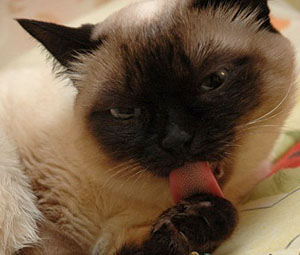
Could this be the U.K.'s only vegetarian cat? Although cats are natural carnivores, Dante is a rescued tom who turns his whiskers up at anything -- except for organic fruit and vegetables. This fussy feline refuses to touch traditional cat food of any kind, favoring ''less fattening'' homegrown alternatives. (South West News Service)
link: http://abcnews.go.com
Showing posts with label cat breeds. Show all posts
Tuesday, April 24, 2012
Saturday, December 31, 2011
abyssinian cats
Cat Breed - Abyssinian
The Abyssinian cat is commonly believed to date back to the 1860s, originating in Ethiopia, yet some people claim that the breed can be traced back to the ancient cats of Abyssinia, now called Egypt.
It is one of the oldest known breeds, the first one being brought to England in 1868. The Abyssinian was officially recognized as a distinct breed in 1882.
They are known for their sharp intelligence, litheness and a refined, pleasant demeanor, often becoming very attached to their owners. Abyssinians are extroverted and willful with a curious and adventurous nature being the norm; they are active, playful and inquisitive!
This cat has a medium length body with well-developed muscles, and short, silky, fine, close-lying coats; their faces have round, almond-shaped eyes, green, hazel or amber in color. They have legs of moderate length; size-wise they tend to weigh between 4-7.5kg (9-16lb).
The tail is fairly long, broad at the base and tapering to a point. Abyssinian's have fine bone structures and their paws are small and oval-shaped.
The cat's ears are alert and relatively large, broad and cupped at the base; they have an M-shaped marking found in fur on the forehead.
The Abyssinian has a "ticked" coat, meaning that each hair, light in color, has several dark bands which are evenly spaced. This coloring results in an ideal camouflage for the dry desert lands of North Africa.
These days, the Abyssinian comes in a range of different colors. Anything from red through fawn, lilac, cinnamon, cream and chocolate, amongst others.
They are a popular cat breed and are generally healthy except for occasional blindness, especially an inherited form called retinal atrophy. Although making good companions they can be suspicious of strangers.
Abys, the term used fondly by owners, are hardy and adaptable as pets and are a popular breed for showing; a good choice for any prospective cat owner!
For other great cat articles, please visit: http://fatherspirit-catablog.blogspot.com
Article Source: http://EzineArticles.com/?expert=David_Braybrooke
Friday, December 30, 2011
tabby cats
Tabby Cats
The tabby cat is the best known type of cat. Indeed, tabby cats are the most common of domestic cats. In fact, the tabby pattern is believed to be the pattern of the cat's wild ancestors.
Tabby is not a cat breed. It is not a color either. In fact, the tabby pattern occurs in different cat breeds and it comes in different colors. Tabby is a pattern.
Tabby patterns
The tabby pattern may include swirls, stripes, whorls, and spots. There are four tabby patterns: the classic, the mackerel, the ticked, and the spotted.
Classic (or blotched) tabbies are one of the most common. This type of tabby will have swirls and clearly defined stripes all over the body. Usually, a thick band or stripe will run all the way from the neck to the tail.
Mackerel tabbies are also very common. Many in fact believe that this is the original pattern dating back to the wild African cats. The mackerel pattern will display vertical stripes at the sides of the body and rings around the legs and tail.
The spotted pattern is said to be a different version of the mackerel pattern. In this pattern, the stripes are broken into big spots all aligned in a single file.
Ticked tabbies are very interesting. At first glance they don't seem to be tabby cats at all. They don't come with the usual whorls, swirls and stripes. They would appear to be of a solid color. Upon a closer look, however, you will see that the fur of ticked tabbies has stripes and swirls.
Tabbies also come in different color variations: you will find red tabbies, silver tabbies, and brown tabbies - to name a few. The tabby pattern also occurs in different cat breeds, including the Bengal, the Bombay and the Egyptian Mau.
© Claudia Escobar is a cat lover who loves anything cat-related. For more on tabby cats and gift ideas for cat lovers visit her site at http://www.cat-lovers-gifts-guide.com. If you would like to reproduce this article please feel free to do so, provided that you publish the article in its entirety and include this resource box.
Article Source: http://EzineArticles.com/?expert=Claudia_Escobar
hairless cats
Hairless Cat Breeds
When people hear the term "hairless cat breeds," they tend to think that the cat is completely bald. This is not true as this type of cat actually has a coat of fine down hair that covers its body.
Even though these cats have less hair than other types of cats, it does not mean that it is a hypoallergenic cat breed. People are allergic to a protein that is present in the saliva of a cat and not the actual hair.
One of the most well known hairless cats is the Sphynx. In Toronto in 1963 a litter of kittens were discovered that had been born without hair. A breeding program was started with these kittens but was discontinued in the late 1970's. In 1978 the last breeding pair was sent to Holland but they did not produce any litters. Kittens that were born without hair due to natural mutations were bred to the Devon Rex - a cat with almost no hair. This established a new interest in the Sphynx and today this different cat breed is recognized for shows by cat fanciers worldwide.
Another of these strange looking cats is the Peterbald cat breed that has the elegant look of the Siamese but without the hair. The coat of this cat is divided into two groups: bald and hairy. A kitten that falls into the bald category is born without any hair, whiskers and eyebrows and stays like this throughout its entire life.
These cats require special care and grooming. Ideally, they should be kept as indoor cats. If allowed to go outside, an animal-friendly sunscreen has to be applied to prevent sunburn.
In the cold winter months, they have to be protected against the cold. This can be done by providing fur-lined baskets and tunnels or by dressing the cat in a soft coat.
This is one cat breed that actually requires a bath. As there is no hair to absorb skin oils, the skin will be greasy to the touch and breeders recommend a bath twice a week to keep the skin in good condition. When bathing this type of cat, use only a veterinary quality product (never human shampoo!) and make sure that there are no drafts. Dry the cat with a soft towel.
Before choosing such a cat, think about the extra care and grooming that they require. You have to be able to make the commitment to ensure that your hairless cat is happy and healthy.
People who love cats come in all shapes and sizes, as do cat breeds. Being informed about the different cat breeds and their needs will ensure that you and your cat have a mutually beneficial relationship.
If you would like to learn more about cat breeds and how to take care of your cat, visit http://www.cat-breed-info.com
Article Source: http://EzineArticles.com/?expert=Christelle_Smith
Monday, December 26, 2011
bengal cats
Bengal Cats
Bengal cats are a new breed, cross-bred with a wildcat. Their spotted or marbled coat is soft and thick, they have a large, sleek muscular build, rounded slighted long face, oval eyes and thick tail. They have an enviable, exotic appearance without the wild temperament of their much larger untamed ancestors.
Characteristics
Bengal came from the taxonomic name of the Asian Leopard Cats (ALC) and not from the more widely known Bengal Tiger species, which is unrelated to the Bengal Cats ancestry. These cats have a series of horizontal stripes on their faces, known as mascara, which extend along the eye to the back of the neck. Their back and sides are marked with spots like those of a jaguar, and the rest of the body, legs and tail, are marked with symmetrical stripes. The spots sometimes have a marbled appearance and are generally made up of two colors. The following colors and patterns are recognized as Bengal Cats and therefore eligible for competition; Brown Spotted Tabby, Brown Marbled Tabby, Seal Mink Spotted Tabby, Seal Mink Marbled Tabby, Seal Sepia Spotted Tabby, Seal Sepia Marbled Tabby, Seal Spotted Lynx Point, and Seal Marbled Lynx Point. These pets are the only variety that sometimes have a pearl or gold dusting, sometimes called glitter, and the texture of their fur is rich and silky-smooth. Bengal Cats even have a different sound in their voice and tend to be very vocal.
Temperament
Originally some of the Bengal Cats inherited the unpredictable temperament of the wildcat, but breeding programs concentrated on breeding a gentler nature. The domestic feline is very lively and active, but also quite self-contained and quiet.
Brief History
As the story goes, Jean Sugden Mills, around 1982 bred a domestic cat with a feral Indian Mau. At about the same time, Greg and Elizabeth Kent started their own breed of Bengal Cats using an Egyptian Mau. Both Jean Mills the Kents worked hard to popularize the this breed, and in 1986, The International Cat Association adopted the first written breed standard. Today Bengal Cats are the most popular registered cat breed.
Care and grooming of Bengal Cats ought to be kept up as any other housecat; frequent combing of fur, good nutrition, regular play and veterinary visits. For more information on the care and feeding of our favorite furry pets, visit: [http://lovefatcats.com]
Article Source: http://EzineArticles.com/?expert=Elsa_Albro
Sunday, December 25, 2011
siamese cats
Siamese Cats - Do You Really Want One?
Are you ready and able to welcome Siamese cats into your heart and home?
Where should you start?
With personality plus. Siamese cats can be high maintenance, more so than most house cats. Don't let this put you off, because when it comes to pure breeds, they are no higher maintenance. In fact, they are a lot less trouble than some of the long haired breeds like the Persian cat, which requires brushing and combing every day.
What does 'high maintenance' mean? Unlike the Persian cat, Siamese cats have a close short coat and although many like a brush they can look after their own coats. This also applies to the long-haired Siamese, called the Balinese or Javanese - they have an easy to manage longer silky coat.
Where they do require more attention is in the mental and psychological area. Without that attention, they will become unhappy, and an unhappy Siamese cat spells trouble. Picture this: shredded furniture and curtains, territory marking and self harming by pulling out their own fur, just for starters.
How does this affect your decision to buy that most tempting, cute and naughty Siamese kitten bundle?
If you are out of the house for hours on end, plan on either more than one Siamese or make real efforts to keep your cat entertained: that means special toys, treats hidden around the house, or special sleeping places by the window.
When you come home, plan on spending some quality time together. It will allow you to re-bond and your cat will forget your time apart.
Another option is a Balinese or Javanese, which also belong to the family of Siamese cats. Some breeders say that with a Balinese or Javanese, you get the character of a Siamese, but generally a more easy-going nature. If you plan on being at work all day, you might consider the longer-haired Balinese over the standard Siamese.
Take some time to think about what you want from your cat.
If the idea of a cat always hanging around, wanting attention, and mewling loudly with that piercing Siamese voice gets on your nerves even as you read this, then this truly might not be the best choice for you.
Do you have a hectic family life? Do you really have the time, energy and inclination to take care of the emotional needs of your Siamese? Remember, a lonely and ignored Siamese will be anti-social and get on your nerves even more - and that's a cruel thing.
Finally all cats cost money, vet bills, food and boarding costs soon add up. It would be so sad to end up having to give your cat away because you could not afford to keep it. If your job takes you away all the time having a Siamese is probably not a good idea. Take some time to think this through, before you buy your Siamese cat!
If you still think you can care and provide for this most special and striking of cats, then read on - because Siamese cats are truly different.
Most owners agree that Siamese cats are special. They look different, with their darker paws and faces and blue eyes. And they have such a distinctive voice - even those who don't love cats can recognize a Siamese.
Siamese cats are on average more clever than most cats, although you can get exceptions.
You will be enchanted with their antics. While elegant in appearance, they can often be quite clumsy. Take care to bolt down all ornaments! Who knows - they may choose to be clumsy just to get your attention. They feel warmer than other cats when you cuddle them, and they love the heat. Those radiator beds are very popular in colder climates. And if you can provide them with the entertainment of a safe outdoor run they will love you for it.
Siamese cats cannot see as well as other cats at night though so watch that they don't come to any harm. Nor are all Siamese noisy, though some can howl the house down. Make sure you have easy-going neighbors who don't wonder why you're torturing your cat!
If you have more than one Siamese you will probably see that unlike the more independent breeds they will love to sleep in a great heap together, another good reason for having more than one. Occasionally, like any other cat, they'll take a dislike to their house mates and will never sleep close together, but this is rare.
Still fascinated by Siamese cats? Still convinced this is the perfect match for you?
That is good news, because a Siamese is truly a special friend.
A word of caution before you buy though: it's the same for all breeds, you should choose your kitten carefully. To avoid heartache, do your research properly and buy from a reputable breeder. After all, the last thing you want is a sick or weak kitten.
Still not put off? Then you will be rewarded with a wonderful special relationship this breed is rightly known for.
Anne Sterck, 'The Siamese Cat Lady', has never been without a cat or two or three! She is presently owned by Cumin, the cutest and naughtiest Siamese cat in France.
Obviously she couldn't include as much information about Siamese Cats and Siamese Kittens as she would have liked here. To get more help in finding your special Siamese Cat friend go to http://www.loving-siamese-cats.com
Choosing your new Siamese cat just got a whole lot easier.
Obviously she couldn't include as much information about Siamese Cats and Siamese Kittens as she would have liked here. To get more help in finding your special Siamese Cat friend go to http://www.loving-siamese-cats.com
Choosing your new Siamese cat just got a whole lot easier.
Article Source: http://EzineArticles.com/?expert=Anne_Sterck
Cats Breeds
Cat Breeds
There are two distinct schools of thought when it comes to cat owners. The majority are quite happy sharing their home with a "moggie" which is any mixed bred cat. Generally, especially after neutering or spaying they are loving affectionate creatures that in return for some tender loving care will give you joy and affection.
However, there is also another school of cat owners who are devoted to one of the pure breeds of cat. There are over 70 plus separate breeds of cat which are officially recognized by the national cat societies. Although cat breeds do not differ in shape and size as much as canines there are still large differences between the various breeds.
In simple terms cats can be divided between short-haired and long-haired varieties British, American and Oriental short-haired varieties come in a range of different colors. Apart from the more common black, white, tabby (calico) and ginger cats there are also cream, lilac and chocolate colored short-haired varieties.
The most well know of the long-haired cat breeds is possibly the Persian. It is believed that the Persian Longhair was probably the fist pedigree breed that was imported into the UK and USA. They are believed to be descended from Angora cats of Turkey and Iran and were bought back to Europe by sailors sometime in the sixteenth century.
Other non Persian long-haired breeds include Angora, Balinese, Chinchilla and Birman. In the USA the Maine Coon is a popular long haired breed as are the Norwegian Forest cat and the Ragdoll. Owners of the long-haired breed will tell you that their pets can be very placid and docile and they seem to lack the aggressive tendencies of some other breeds. On the downside long-haired cats do require a great deal of grooming and are very prone to getting hairballs.
Short-haired breeds include Abyssinian American Wirehair, Bengal, Egyptian Mau, Rex and of course the Siamese considered by some to be the real aristocrats of the cat world. Because of their short coats they do not need as much grooming as their long haired cousins.
Pedigree cats tend can cost a lot of money especially if they are descended from winners at major cat shows. Whether you opt for "moggie" from your local cat rescue centre or go to a specialist breeder you are going to a pet that is going to become part of yours and your family's life.
Being a cat owner comes with responsibilities you need to know about Cat Care. To find free articles about looking after your cat visit http://www.cat-lovers.co.uk
Article Source: http://EzineArticles.com/?expert=D_J_Bromley
Saturday, December 24, 2011
cat
Cat Evolution
Cats are loved by their owners for being individualistic & independent, yet they are often accused by non cat owners of being aloof and/or arrogant. Recent studies conclude this is largely due to the fact they have no eyebrows. Some people then perceive them to posses a flaw in their personality, a coldness not seen in other domestic animals such as dogs.
This is of course not true, when a cat purrs and rubs up against their owner this is a definite show of affection, just like the wagging of a dogs tail.
Cats are first thought to have been domesticated by people on the island of Cyprus about 9,500 years ago and originated from only about five self domesticating African Wildcats (Felis silvestris lybica) which would have lost their fear of humans and come looking for food when prey dried up due to naturally occurring weather conditions.
Cats are very similar to their lion & tiger relatives. They posses the same strong flexible bones & super quick reflexes & the same retractable claws, making it easy for them to run at their pray & then capture it.
The cat is a nocturnal predator, its eye operates differently to a human eye, making it possible for him/her to see far better than other animals in reduced light situations, due to the fact it has a special layer of cells at the back of its retina, called the tapetum lucidum which reflects light back to the cells of the retina, essentially giving the eye another chance at collecting light. Cats have also evolved to hear fainter and much higher frequencies than we can, which is why they know there is a mouse in the cupboard long before we do.
Caring for your cat
As a cat owner you can have a huge impact on the health and well being of your companion by undertaking routine preventive healthcare at all stages of its life - from kitten hood through to old age. This offers the best chance of preventing problems arising or, at least, maximising the detection of any illnesses early on.
Owning a new kitten means you will have to vaccinate at around 8 weeks old, and then again at about 12 weeks. To maintain immunity, all adult cats require annual boosters.
Worming
The most common intestinal worms affecting cats in Australia are roundworm, hookworm, and tapeworm. Worms are a common cause of ill health in pets and can result in a loss of appetite, vomiting and diarrhea.
To protect your cat, common worms can be easily controlled with a routine worming treatment. Kittens need to be wormed every two weeks until twelve weeks of age, then monthly until six months of age.
For more great tips on pet care go to http://www.captncanary.com/
Article Source: http://EzineArticles.com/?expert=Brendan_L_Williams
Subscribe to:
Posts (Atom)