INFL

Showing posts with label crocodile. Show all posts

Thursday, May 3, 2012

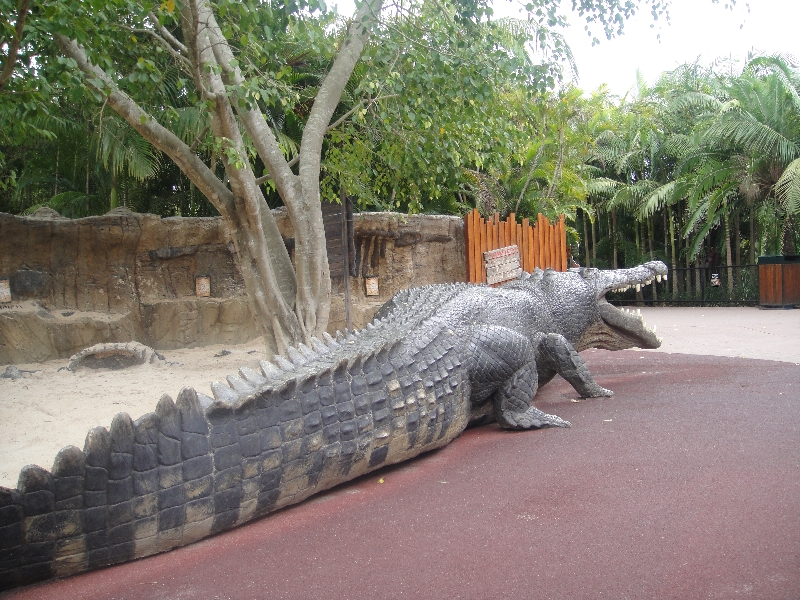
Saltwater crocodile


Hunters and villagers in the south Philippines captured alive a one-ton saltwater crocodile this week. The 21-foot male croc was captured along a creek in Bunawan township in Agusan del Sur province. Captured after a three week hunt, the massive crocodile killed a water buffalo in an attack witnessed by several village residents. (AP Photo)


link: http://abcnews.go.com

Tuesday, January 31, 2012

crocodile pictures


How to Draw a Crocodile

Crocodiles are the oldest reptiles (200 million years old) that resemble a huge lizard. Undoubtedly the most intimidating of all reptiles, crocodiles are divided into 23 different species with the biggest ones called 'saltwater crocodile' and the smallest, 'dwarf crocodile.' Most species can be found in Africa and in some regions of Asia.


With a life span of around 50 to 60 years, crocodiles are ambush predators. They patiently wait for their prey to come close enough for the attack and then strike fiercely, leaving not much option for escape. Crocodiles have well-built jaws, fitted with sharp teeth to kill. They mostly feed on vertebrates, like fish, reptiles, and mammals. These cold-blooded animals can stay up to a year without a kill. Crocodiles are inclined to flock in water territories like rivers, swamps, lakes, everglades, wetlands, and saline water.
The steps here guide on drawing these formidable creatures.
Required tools:
1. Pencil
2. Paper/canvas
3. Colors
4. A reference picture
Easy steps to draw a crocodile
Basic outline:
• Face: Trace out an egg shape for the head. Manipulate it to form snout and mouth at the left (narrower) end of the oval. Trace a wavy line in the middle of the snout as a guideline for the jaws. Shape out small eyes, a small black slit for pupil, semi-circular eyelids on the top of eyes, a broad snout, and a bulky neck. Darken the eyes and the nostrils. Draw the rest of the shape of the open bottom jaws by adding razor sharp teeth and a tongue. Depict some tough skin detailing on its head above the eyes.
• Body: Add a long oval at the broader end of the head. This will be the body of your crocodile. Behind the head, supplement with spiky lines going down its back all the way to the tail. Add on wrinkles, lines, and folds around the neck, bottom of the belly, and the toes.
• Limbs: Mark two oval, muscular visible legs & feet at the anterior and posterior ends of the body. Keep them short and stout, full of lines. Draw four sharp claws.
• Tail: At the right end of the body, draw two curved thick lines, joining at the tip, for the tail. Sketch out some razor edged, small triangles until the end of the tail.
• Final changes: Erase all the guiding lines. Darken the bodyline with a black marker. It can be bumpy lines. You can give a waterscape in a dense forest. Indulge with a bit of color and imagination, befitting a real crocodile.
Annette Labedzki received her BFA at the Emily Carr College of Art and Design in Vancouver, B.C. Canada. She has more than 25 years experience. She is the founder and developer of an online art gallery featuring original art from all over the world. Please visit the website at http://www.Labedzki-Art.com. It is a great site for art collectors to buy original art. Artists can join for free and their image upload is unlimited.

largest crocodile ever


Be Crocodile Wise in Australia

Many people have a lot to learn about the dangers of a saltwater crocodile while visiting northern areas of Australia. Many encounters are unintentional and often the results are devastating if not fatal. People should learn more about the crocodile, where they breed, how to spot for signs of crocodile, their most active periods of the year and general safety when camping near water. The following information is to help people realize the dangers of swimming in northern Australian waters.


Many accidents can be avoided with increased awareness.
It's common name, the Saltwater Crocodile, is also known as the Estuarine Crocodile and 'Saltie'. They are found around the coast of Australia anywhere north of the Tropic of Capricorn and inland for up to 100 kms or more. They are the world's largest reptile and have a closing jaw pressure of around 3000 pounds per square inch.
Saltwater crocodile attacks DO happen in Australia on a regular basis, though the majority of attacks occur mainly on cattle and wildlife. Any stories you hear about these creatures stalking other animals and humans, about their size and their strength is probably NOT exaggerated. Many deaths to people have happened over the years due to them not taking the threat seriously enough and ignoring warning signs.
Always read the "observe crocodile warning signs", these are to be taken seriously! They are erected in that particular area where a crocodile is frequently spotted and could still be living or even breeding in that area. These signs are there to warn the people of the risk and should never be ignored!
Just because you don't see a crocodile doesn't mean it's not there!
Their breeding season is from September to May and the warmer weather makes the cold-blooded animals even faster. Be particularly careful at night! A breeding mother is more aggressive, guarding it's eggs until they hatch. The nests are made from plant matter and mud, and usually found above tide level. Keep this in mind when setting up camp or just exploring the bush.
Avoid places where animals or cattle drink. That's where a crocodile would be waiting for an opportunity to attack. Saltwater crocodiles are very conservative with their energy. They stalk their prey and hide underwater and wait to pounce. A crocodile you can see is less dangerous than one you can't see, so stay well away from the water's edge even if you are camping, fishing or just going for an evening walk.
Crocodiles can launch out of the water; never stand on logs overhanging water and always keep your arms and legs inside a boat when fishing.
No warning signs? DO NOT SWIM no matter how hot or inviting the conditions may be. The "saltie" is mostly found in saltwater, but they are also found in freshwater rivers, billabongs and swamps. Consider swimming in any northern waters dangerous regardless if there is a sign or not!
A crocodile sliding into the water from a river bank will leave a characteristic mark; keep this in mind when setting up camp! Never clean fish at the water's edge or discard fish scraps in the water. Most important if camping always keep the camp site clean and free from food scraps and any smelly fish bait. Remember crocodiles are most active at night, food scraps and fish bait left outside your camp site can invite a hungry crocodile and a shocking midnight scare.
Adult males can reach sizes of up to 6 or 7 metres (20 to 23 feet).
Maximum weight varies, but has been known to exceed 1,000 kg in 18 to 19 foot adults. 5 metre adults are closer to 400 to 500 kg.
One of the largest crocodile ever recorded in Australia was 8 metres 64cm (28ft 4 inches) shot by Krystina Pawloski on the Norman River in North Queensland in 1957. Never torment or provoke a crocodile. They are a protected animal to stop poaching and should always be left alone.
Always remain crocodile wise when traveling to northern parts of Australia and always keep the previous information in mind to avoid any tragedies or loss of life.
Be safe and enjoy your trip!
Jamie Stone jamiestone4870@hotmail.com Australian Freelance Writer.

crocodiles


Killer Crocodiles - How One Man Campaigned For Their Survival

Crocodiles have become big business - for the tourist industry and for handbag manufacturers.
These days you can fly into Northern Australia and be treated to a variety of nerve-tingling thrills. On the Adelaide River, just south of Darwin in the Northern Territory, several operators offer close encounters with the hungry monsters.
They dangle pieces of meat off the side of open boats and up leap the crocs to enjoy their lunch, their massive snapping jaws only inches away from the tourists.


At Crocosaurus Cove in Darwin you can enter the Cage of Death, a transparent acrylic box which is lowered into the enclosures of three giant crocodiles. If they are in a bad mood, watch out!
These days thousands of the saurians are farmed for their prized skins and for their meat too. Australia has awakened to the fact that these primeval creatures are not a curse but an asset.
That's quite a change from the time when I lived in Australia's wild north and became friendly with a pioneer in crocodile farming.
Ron Pawlowski and his wife Kris emigrated to Australia from their native Poland after suffering hardship and hair-raising adventures during World War Two. Good training for the tough life in the Outback.
As a new and penniless immigrant, Ron did everything from gold-prospecting to kangaroo hunting. Then the couple based themselves in a remote corner of the Gulf of Carpentaria in Queensland and became expert crocodile-hunters.
In 1957 Kris, a first-class shot, killed a monster, 28 feet four inches long, the biggest croc ever bagged in Australia. All manner of far-fetched stories have circulated about monster crocodiles, but in this case there appears to be no doubt about the facts.
Kris's feat made her famous and won her a mention in the Guinness Book of Records. She noted: "I would never shoot one like that again. It was such a magnificent specimen."
Altogether the Pawlowskis shot up to 10,000 salt-water crocodiles, which they sold for their skins. They became legends - and then conservationists, as they realised that the species was endangered.
They started campaigning for the protection of the crocodiles and for the establishment of farms where the reptiles could be raised for their prized skins.
But they were before their time and could get no support from the politicians ruling the state of Queensland. They were forced to give up their own croc farm.
Ron continued his campaign, even giving evidence before members of Australia's parliament. Finally, the national government ordered both salt-water and fresh-water species to be protected
Numbers have swollen dramatically. Crocodile-rearing farms have been established all over the north and are reaping big profits.
If you visit Australia and get to see one of the croc farms, remember the man who helped to save the saurian, Ron Pawlowski, an indomitable survivor of the horrors of war who built a new life in a new land - and made a difference.
Today he lives peacefully in the resort of Cairns, handy for those who want to visit the Barrier Reef.
Journalist and author David Baird wrote a book about his experiences in northern Australia, title The Incredible Gulf. He has worked for publications all over the world. He is now based in Spain. His book Between Two Fires - Guerrilla War in the Spanish sierras has won praise from leading historians. His latest books are works of fiction, Typhoon Season, a nerve-tingling thriller set in Hong Kong, and Don't Miss The Fiesta!, passion and adventure played out in southern Spain. More information at the Maroma Press website, http://maromapress.wordpress.com/

crocodile


Siamese Crocodile: Endangered Species

The Siamese crocodiles, as being defined, are freshwater crocodiles that can be found usually in East Malaysia, Thailand, Indonesia, Vietnam, Burma, Brunei, Laos and Cambodia. It has a scientific name "Crocodylus siamensis", Crocodylus which is derived from the Greek word krokodeilos meaning "pebble worm "and siamensis which means "of Siam". This type of crocodile is considered as an endangered species from many regions nowadays.


Facts and Information about Siamese Crocodiles
There are certainties with this lizard-like wild animal. Here are some of those: 
  • The female Siamese crocodiles can lay their eggs once a year in either month of April or May.
  • There are various common names of this kind of crocodile. These include Cocodrilo de Siam, Buaja, Soft-belly, Buaya kodok, Singapore small grain, Siamese freshwater crocodile and Jara Kaenumchued.
  • Crocodylus siamensis refers to Siamese crocodile's scientific name.
  • One of the most valuable reptile hides of this crocodile is their skin which has small to medium size scales with no osteoderms or bony bumps.
  • This Siamese lizard-like wild animal prefers to live in slow moving waters similar to rivers, swamps, and some lakes.
  • Most Siamese crocodile adults do not tend to exceed their length in three (3) meters.
  • The Siamese freshwater crocodiles are known to eat fish. They perhaps also catch amphibians and reptiles like snakes, frogs, small mammals, insects and other small prey species. Those in captivity are also fed chickens with the feathers removed.
  • Siamese crocs have unknown life span although male crocs mature at 10 years.
  • They are relatively inoffensive compared to other species of crocodile. They are low treat to humans because they attack only when we started to attack them.
  • Siamese crocodiles are now critically vanishing due to excessive hunting and habitat loss.
There are reasons why saving these crocs for extinction is a must. One of those is that, these crocs might possess materials that could be used in medicine for people. Thus, these might add our knowledge of science.
Do you want to adopt cats? Then, read this article and learn more!

crocodile


Never Smile at a Crocodile - The Increasing Number of Crocodile Attacks

Crocodiles - An Ancient Line of Predators
Today there are something like twenty-two species of reptile that make up the Order Crocodylia. Of these species; only thirteen are actually true crocodiles, the remainder are Alligators, Caiman and the extremely rare and endangered, long-snouted gavials, sometimes referred to as gharials. We often get asked how to tell the difference between a crocodile and an alligator. There are a number of anatomical differences between crocodiles and alligators, when observing these reptiles look for a large, fourth tooth in the lower jaw. When the mouth is closed this tooth fits into a notch in the upper jaw and the tooth remains visible even when the mouth is closed. If you can see this tooth, then you are looking at a crocodile.


There are only two species of Alligator left in the world. Firstly, as most people know, there is the American alligator (alligator mississipiensis), which can be found widely distributed across the south-eastern United States, most typically in the Florida Everglades. There is also a second extant species of alligator, although this one is much rarer and confined to the upper Yangtse River valley in China. Scientists had thought that the less aggressive alligator had been "weeded out" of its range by crocodiles, leaving the only representatives of the Alligatoridae family in these isolated pockets. The more efficient crocodiles grew faster and may have been better at consuming food but this is generally regarded as speculation - as in the case of the American alligator, this species competes with the native American crocodile (C. acutus). The American alligator can withstand cold spells far better than the American crocodile, and as a result, has a much more extensive range in the United States.
Crocodylia in the "New World"
The idea of a "less aggressive" member of the Order Crocodylia is also a contradiction in terms. In the USA, once an Alligator reaches a length in excess of 4 feet it is regarded as dangerous to people. Alligator incidents are frequent, beginning in the spring when the warmer weather makes these cold-blooded reptiles more active and they begin to roam more widely. Fortunately, attacks on humans are relatively rare, although they do occur especially where people have been foolish enough to encourage alligators by feeding them. In some parts of the southern United States, special warden teams have been formed who work on a twenty-four call out service capturing and removing alligators that have wandered into areas of human habitation and got into contact with people. Specimens over 3 metres long are exceptionally rare in the wild but these reptiles, with their powerful jaws are still extremely dangerous and should be treated with caution. There is even a countryside code which has been developed by park rangers - a sort of "dos and don'ts" when in American alligator territory.
Crocodylia in the "Old World"
The majority of fatal attacks occur in Asia and northern Australia. Whilst we at Everything Dinosaur, would contend that all species of crocodilian are dangerous and that even a baby crocodile emerging from its egg is quite capable of giving you a nasty bite on the end of your finger - perhaps two of the most dangerous species of crocodile in the world can be found in Asia and Australia.
The "Mugger"
Let us deal with the Mugger crocodile, otherwise known as the Swamp crocodile (Crocodylus palustris). The term "Mugger" does not describe this reptile's habit of attacking humans, the word is a corruption of the Urdu dialect meaning "water monster" and what a beast this creature is. Large specimens can measure up to fourteen feet long and it is a proven man-eater. Although endangered, this crocodile can be found throughout freshwater river systems and marshes on the Indian sub-continent. It is aggressive and large crocodiles specialise in ambushing prey as they come to the water's edge to drink. Unfortunately, people are also attacked by this crocodile, notably children who might be fishing or given the job of fetching water. A number of fatal incidents are reported each year. The Mugger crocodile superficially resembles the Nile crocodile of Africa (Crocodylus niloticus) but it can be distinguished by its shorter, broader snout and the arrangement of prominent scutes (armoured plates) that can be found along the back of this particular crocodile.
The Estuarine Crocodile
The majority of fatal crocodile attacks are put down as being attacks from the Estuarine or "Saltwater" crocodile (Crocodylus porosus). This crocodile can be found across almost the entire Pacific, from Sri Lanka to the Fiji islands, including the northern territories of Australia. This is the largest surviving species of reptile in the world today, with large males growing to more than twenty-two feet in length and weighing more than one tonne. Although, not as big as a dinosaur such as Tyrannosaurus rex, this crocodile is still an extremely formidable predator and it is responsible for a number of fatal attacks each year. Unfortunately, the number of attacks are increasing. This is due to a number of reasons:
1). Increasing crocodile numbers - poaching in the 20th Century led almost to the extinction of this crocodile species in some parts of its range. Once controls on poaching were put in place and hunting restrictions imposed Estuarine crocodile numbers rapidly increased. More crocodiles in rivers and estuaries has led to an increase in crocodile attacks.
2). Decline in natural game - hunting and habitat clearance, as well as over fishing has led to a decline in the natural prey of these large crocodiles. This is particularly noticeable in countries such as Indonesia. As a result, this has led to a number of crocodiles attacking people close to riverbanks and other bodies of water.
3). Increasing human populations - expanding populations in south-east Asia, the expansion of towns and estates in northern Australia has brought more and more people into contact with large saltwater crocodiles. As a consequence, incidents involving crocodiles have grown dramatically.
4). More tourists exploring known crocodile "hot spots" - the growth in the tourism industry in south-east Asia and northern Australia has led to more people visiting and camping in areas where crocodile attacks are known to have occurred.
Recently, a fourteen-year-old, Indonesian boy was dragged from a boat and fatally mauled by a large Estuarine crocodile. Attacks on unwary Australian tourists are on the increase. A dentist, fishing off the coast of the northern Territory was lucky to escape with his life after a crocodile attacked. We read about and indeed we at Everything Dinosaur, report on a number of such incidents each year.
It is difficult to accurately document the number of fatal crocodile incidents each year, we have highlighted the problems with just two species and in writing this article we have not discussed the many crocodile attacks carried out in Africa by the Nile crocodile. Calculating the number of incidents is difficult, most attacks take place in remote areas, most of them impoverished so accurate records are often not kept. It is important that visitors to these areas should heed the warnings of locals and also to consider their own safety when getting close to water. It is worth remembering that a five metre long crocodile can hide in less than 30 centimetres of muddy water!
Remember the old saying "never smile at a crocodile".
Everything Dinosaur is a company run by parents, teachers and real dinosaur experts. It specialises in developing educational dinosaur toys, models, clothing and games and strives to help young people learn more about science through their fascination with prehistoric animals. Many of the items featured on the Everything Dinosaur website http://everythingdinosaur.com/ have been designed and tested by the teachers and real dinosaur experts in the company.
To learn more about the products and services we offer at Everything Dinosaur click on our website links.
Our aim is to help young people learn more about Earth sciences through their fascination with dinosaurs and other prehistoric animals. Team members are happy to provide advice and support supplying free quizzes, drawing materials, puzzles, games even recipes for dinosaur themed biscuits and birthday cakes. With something like 600 products on line including dinosaur party supplies, Everything Dinosaur http://everythingdinosaur.com/ has built up a strong reputation assisting parents, guardians and fellow teachers, helping young people to learn more about science through creative play.