INFL

Saturday, July 14, 2012

Wolverines need refrigerators


Study: Wolverines Need Refrigerators

ScienceDaily (July 12, 2012) — Wolverines live in harsh conditions; they range over large areas of cold mountainous low-productivity habitat with persistent snow. The paper suggests wolverines take advantage of the crevices and boulders of the mountainous terrain, as well as the snow cover to cache and "refrigerate" food sources such as elk, caribou, moose and mountain goat carrion, ground squirrels and other food collected during more plentiful times of year.

Wolverine. (Credit: Mark Packila, WCS)
These cold, structured chambers provide protection of the food supply from scavengers, insects and bacteria. In addition, the refrigerated caches increase the predictability of available food resources, reduce the energy spent by females searching for food while in lactation phase, and decrease the time mothers spend away from cubs.
The paper appears in the current edition of the Journal of Mammalogyand was co-authored by Robert M. Inman of WCS, Audrey J. Magoun of Wildlife Research and Management, Jens Persson of the Swedish University of Agricultural Sciences, and Jenny Mattisson of the Norwegian Institute for Nature Research.
"People don't normally think of insects and microbes as being in competition for food with wolverines," said lead author Robert Inman of the Wildlife Conservation Society's North America Program. "But in fact, bacteria will devour an unprotected food source if that source is available."
Through an extensive literary review, the authors noted that wolverine reproduction is confined to a brief period of the year, and the lactation phase in females (February through April) corresponds to a period of low availability of food resources. Wolverines, which are opportunistic foragers, have adapted by amassing food caches during the preceding winter months when food is more readily available. Without the cached food supply or an unforeseen alternative (such as a winter-killed ungulate), early litter loss occurs.
Inman said, "Understanding why and how wolverines exist where they do and the various adaptations they have evolved to eke out a living will better inform population management strategies and conservation of the species."
Climate change will play a key role in management planning for the conservation of wolverines, the authors say.
In a study published in 2010, wolverine biologists demonstrated a relationship between the areas where wolverines exist (their distribution) and persistent snow cover. The first theory advanced was that wolverines must have deep snow available in springtime so that they can give birth to their small cubs in a warm, secure den. The newly released study suggests that other factors related to climate and snow pack, such as competition for food, may also be involved in explaining the limits to wolverine distribution.
Because of their dependence on snow pack, wolverines were recently listed as warranted for protection under the Endangered Species Act due in large part to the threat of climate change reducing distribution and habitat connectivity. The authors say that a deeper understanding of how and why wolverines use snow pack the ways they do is critical to understanding how climate change will impact survival and reproductive rates. "Shedding light on the specific mechanism of how climate will affect wolverines is important in order to know what to do to help them hold on," said WCS's North America Program Director, Jodi Hilty.
Inman and co-authors published a study in December of 2011 on the spatial ecology of wolverines in the Journal of Wildlife Management. This latest paper represents the second of several that will help to inform a conservation strategy for the species.
Story Source:
The above story is reprinted from materials provided byWildlife Conservation Society, via Newswise.
Note: Materials may be edited for content and length. For further information, please contact the source cited above.

Journal Reference:
  1. Robert M. Inman, Audrey J. Magoun, Jens Persson, Jenny Mattisson. The wolverine's niche: linking reproductive chronology, caching, competition, and climate. Journal of Mammalogy, 2012; 93 (3): 634 DOI: 10.1644/11-MAMM-A-319.1

Friday, July 13, 2012

Aggressiveness in dog


If Your Dog Is Aggressive, Maybe It Is in Pain

ScienceDaily (June 13, 2012) — Dogs can sometimes suffer sudden episodes of aggression without their owners understanding why. But, in many cases, the cause of these attacks can be pain that has never been diagnosed or treated. For the first time the study describes the characteristics of this irritability, which can make dogs violent and increase aggression in already conflictive individuals.

The pain produced by hip dysplasia is a key factor in the risk of large dogs becoming aggressive. (Credit: Alex E. Proimos)
There are many factors that explain aggression in dogs: the conditions of the mother during gestation, the handling of the puppy in the neonatal phase, the age at weaning, the experiences of the animal during the socialising phase, diet, exercise, genetics and learning techniques based on active punishment during adulthood. However, aggressive behaviour also arises from the presence of pathologies and pain in the dog.
Between 2010 and 2011 a team of researchers from the department of Animal and Food Science at the Autonomous University of Barcelona (UAB) in Spain analysed the aggression problems of 12 dogs (Giant schnauzer, Irish setter, Pit-bull, Dalmatian, two German shepherds, Neapolitan Mastiff, Shih-tzu, Bobtail, Catalan Sheepdog, Chow-chow and Doberman) who were brought to the UAB's Veterinary Hospital by their owners.
"All (eleven males and one female) were diagnosed as having aggression caused by pain. Out of the 12 studied, eight had suffered a hip dysplasia," as was outlined by Tomás Camps, lead author of the study that was published in the Journal of Veterinary Behavior and researcher at the Animal Nutrition and Welfare Service of the UAB.
Scientists identified the most frequent circumstances in which dogs were aggressive, the most characteristic positions, the most frequent target of attacks and if they were impulsive or, in other words, whether or not they showed signs before an imminent attack.
The study shows that dogs that were already aggressive for other reasons before the onset of pain attacked their owners more intensely and frequently when food was taken away, when they were moved from their rest area or when they were made to do something. Animals displayed aggression in the same situations (or nearly) as those that were already aggressive.
On the other hand, "dogs that had never been aggressive before the onset of pain began to behave in this way in situations were an attempt is made to control them," points out Camps.
In addition, the study shows that those dogs were more impulsive or, in other words, attacked with no prior warning in the form of growls, for instance. The research team states that "if the pet is handled when in pain, it will quickly act aggressively to avoid more discomfort without the owner being able to prevent it."
Diagnosing hip dysplasia
Canine hip dysplasia affects more than 40% of Golden Retrievers, Labradors and Rottweillers and is a hereditary and degenerative bone disorder that affects the joint connecting the hip and the femoral head. In general, it can affect any breed of large dog but is less frequent is small breeds.
The new study suggests that the pain produced by hip dysplasia is a key factor in the risk of large dogs becoming aggressive. But the problem begins when the dog experiences periods of little pain and the illness is not diagnosed on time.
The researchers have reassessed the importance of diagnosis and treatment of pain since, according to Camps, "it can cause aggression or worsen aggression problems."
Story Source:
The above story is reprinted from materials provided byPlataforma SINC, via AlphaGalileo.
Note: Materials may be edited for content and length. For further information, please contact the source cited above.

Journal Reference:
  1. Tomás Camps, Marta Amat, Valentina M. Mariotti, Susana Le Brech, Xavier Manteca. Pain-related aggression in dogs: 12 clinical cases. Journal of Veterinary Behavior: Clinical Applications and Research, 2012; 7 (2): 99 DOI:10.1016/j.jveb.2011.08.002

Wednesday, July 11, 2012

Chickens and Cancer


Ordinary Chickens May Be Extraordinary in Fighting Cancer and Other Diseases

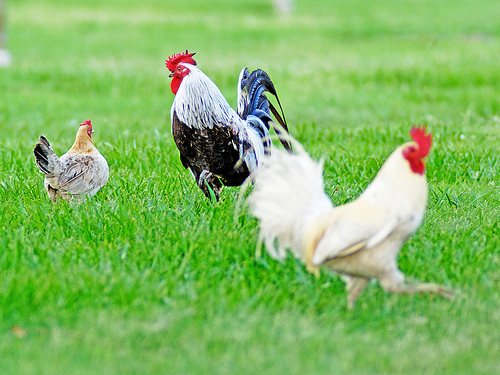
ScienceDaily (July 10, 2012) — The common barnyard chicken could provide some very un-common clues for fighting off diseases and might even offer new ways to attack cancer, according to a team of international researchers that includes a Texas A&M University professor.
James Womack, Distinguished Professor of Veterinary Pathobiology in the College of Veterinary Medicine & Biomedical Sciences, is co-author of a paper detailing the team's work that appears in the current issue ofPNAS (Proceedings of the National Academy of Sciences). Womack was a leader in the international effort to sequence the cattle genome in 2004.


Womack and the team, comprised mostly of scientists from the Seoul National University in Korea, examined 62 White Leghorn and 53 Cornish chickens for diversity in NK-lysin, an antibacterial substance that occurs naturally in animals and is used as a method of fighting off diseases.
They were able to obtain two genetic variations of NK-lysin and the results offered two unexpected shockers: both showed abilities to fight off bacterial infections and other diseases, while one showed it could successfully fight cancer cells as well.
"It took all of us by surprise," Womack says of the findings.
"One of the genetic variations shows it has the ability to fight against cancer cells much more aggressively than the other variation. We certainly were not looking at the cancer side of this, but there it was."
Womack says the team selected the two breeds because Cornish and White Leghorn chickens, found throughout most of the world, have relatively diverse genetic origins.
After conducting a DNA sequence of the chickens, the team found two variations of the genes that offered clues as to their protective ability to ward off infections.
"One form appears to be more potent in killing off cancer cells than the other, and that's the one that naturally caught our eye," Womack adds.
"This could lead to other steps to fight cancer or in developing ways to prevent certain infections or even diseases. It's another door that has been opened up. We are looking at similar studies right now to see if this is possible with cattle.
"The next step is to work with other animals and see if similar variants exist. We need to look for any genetic similarities to the chicken variants and then determine if these variants affect the health of the animal, but this is an exciting first step in this direction."
Story Source:
The above story is reprinted from materials provided byTexas A&M University, via Newswise.
Note: Materials may be edited for content and length. For further information, please contact the source cited above.

Journal Reference:
  1. Mi Ok Lee, Eun-Hee Kim, Hyun-Jun Jang, Mi Na Park, Hee-Jong Woo, Jae Yong Han, and James E. Womack. Effects of a single nucleotide polymorphism in the chicken NK-lysin gene on antimicrobial activity and cytotoxicity of cancer cells. PNAS, July 10, 2012 DOI:10.1073/pnas.1209161109