INFL

Showing posts with label chickens. Show all posts

Wednesday, July 11, 2012

Chickens and Cancer


Ordinary Chickens May Be Extraordinary in Fighting Cancer and Other Diseases

ScienceDaily (July 10, 2012) — The common barnyard chicken could provide some very un-common clues for fighting off diseases and might even offer new ways to attack cancer, according to a team of international researchers that includes a Texas A&M University professor.
James Womack, Distinguished Professor of Veterinary Pathobiology in the College of Veterinary Medicine & Biomedical Sciences, is co-author of a paper detailing the team's work that appears in the current issue ofPNAS (Proceedings of the National Academy of Sciences). Womack was a leader in the international effort to sequence the cattle genome in 2004.
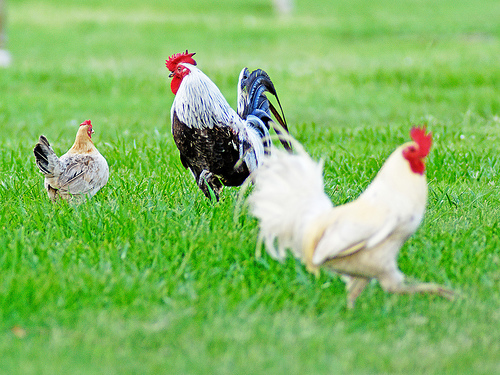

Womack and the team, comprised mostly of scientists from the Seoul National University in Korea, examined 62 White Leghorn and 53 Cornish chickens for diversity in NK-lysin, an antibacterial substance that occurs naturally in animals and is used as a method of fighting off diseases.
They were able to obtain two genetic variations of NK-lysin and the results offered two unexpected shockers: both showed abilities to fight off bacterial infections and other diseases, while one showed it could successfully fight cancer cells as well.
"It took all of us by surprise," Womack says of the findings.
"One of the genetic variations shows it has the ability to fight against cancer cells much more aggressively than the other variation. We certainly were not looking at the cancer side of this, but there it was."
Womack says the team selected the two breeds because Cornish and White Leghorn chickens, found throughout most of the world, have relatively diverse genetic origins.
After conducting a DNA sequence of the chickens, the team found two variations of the genes that offered clues as to their protective ability to ward off infections.
"One form appears to be more potent in killing off cancer cells than the other, and that's the one that naturally caught our eye," Womack adds.
"This could lead to other steps to fight cancer or in developing ways to prevent certain infections or even diseases. It's another door that has been opened up. We are looking at similar studies right now to see if this is possible with cattle.
"The next step is to work with other animals and see if similar variants exist. We need to look for any genetic similarities to the chicken variants and then determine if these variants affect the health of the animal, but this is an exciting first step in this direction."
Story Source:
The above story is reprinted from materials provided byTexas A&M University, via Newswise.
Note: Materials may be edited for content and length. For further information, please contact the source cited above.

Journal Reference:
  1. Mi Ok Lee, Eun-Hee Kim, Hyun-Jun Jang, Mi Na Park, Hee-Jong Woo, Jae Yong Han, and James E. Womack. Effects of a single nucleotide polymorphism in the chicken NK-lysin gene on antimicrobial activity and cytotoxicity of cancer cellsPNAS, July 10, 2012 DOI:10.1073/pnas.1209161109

Friday, May 18, 2012

How to raise chickens?

How to raise chickens in the city

(NaturalNews) Depending on where you live in the world, keeping a few chickens is generally a viable option, even in a large city. Relatively inexpensive and maintenance free, hens will reward you with fresh eggs daily, assist with pest control, provide manure for the garden and give lots of joy to children, who usually love raising chicks.


What hens are best to buy for cities or suburbs?

People often tend to acquire chickens without researching breeds. At poultry auctions, the runts and poor layers are usually readily available, and one will be starting off with very poor stock if these chickens are purchased. Day old chicks for sale are very often males because battery chicks are sexed the day they hatch; females are kept for mass egg production and the "worthless" male chicks are sold to the unsuspecting.

Research carefully the kind of bird needed for your family before rushing out to buy. Are you looking for egg production, a bird to provide meat, or one that is good for meat and eggs, or are you not interested in consumption but simply want a scratcher to assist with bug control? Decide if you want point-of-lay hens (more expensive) or younger chicks (more work and equipment investment needed).

Taking care of chickens in the city

Build a coop that can be moved, with a lid that can be opened or removed. The hens will need a safe, secure place where cats and dogs cannot get in. Dogs can be trained to live alongside hens, but not if they are hunting dogs.

Hens will need a pole to roost on at night, which can easily be inserted into the coop. Clean straw must be provided for laying hens. Clean the coop regularly, remove the straw and add to the compost heap. The manure chickens provide is a great accelerator for the composting process.

If left to free range in the garden, chickens will deal with a snail or slug problem, but they may destroy a vegetable or flower patch if allowed to run loose for a long time. Allow them time to roam and do what chickens are designed to do - scratch and have a sand bath.

In winter, make sure they are dry and warm. Check on them regularly - a poorly managed flock can become a financial drain and they can end up sick and diseased. Be sure to find a responsible "chicken sitter" to take care of them when you are away.

What to feed hens

Give hens plenty of fresh greens, crushed egg shells, warm oatmeal porridge or mash, a scrambled egg now and again, snails and slugs, weeds from the vegetable patch and plenty of fresh water. They will scavenge and scratch very happily on their own for any other nutrients they can find.

Keeping chickens in the city - what are the laws?

The first thing to do is check with your local municipal offices to ask what the laws are in your area and/or whether or not there are limits on the amount of poultry that can be kept in the city or suburb where you live.

Sources:

http://home.centurytel.net/thecitychicken/chickenlaws.html
http://www.suite101.com/content/how-to-raise-city-chickens-a190943
Shared Earth Magazine, pages 26 - 33, Article "Sustainable Poultry" by Sean Freeman

About the author

Fleur Hupston is a professional freelance writer. She is passionate about natural, healthy living and is currently studying to be a naturopath. She divides her time between writing for Natural News and various other sites, home schooling her children and studying part time.

Learn more:http://www.naturalnews.com/030484_raising_chickens.html#ixzz1vF6ECorq
