INFL

Thursday, April 19, 2012

colony collapse disorder

Colony Collapse Disorder in bees triggered not just by pesticides, but also by GMO high-fructose corn syrup
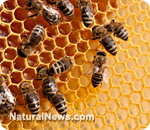


(NaturalNews) Studies linking neonicotinoid pesticides to Colony Collapse Disorder (CCD), a condition in which entire bee colonies suddenly disappear or die, have been gaining national attention in recent months as they continue to flood scientific journals. But one area that has been largely overlooked is the role high-fructose corn syrup (HFCS) plays in killing off bees, as the vast majority of it comes from genetically-modified (GM), pesticide treated corn crops.

Chensheng Lu, Kenneth M. Warchol, and Richard A. Callahan from theDepartment of Environmental Healthat theHarvard School of Public Healthexamined the effects of imidacloprid, a neonicotinoid pesticide, on bee colonies as part of a recent review. Part of this research involved using HFCS that had been derived from corn crops treated with imidacloprid, for which the pesticide ended up getting into the end product.

For their study, the team created four honey bee sites with five honey bee hives each, for a total of 20 hives, with each site containing four imidacloprid hives and a control hive. Among the 16 hives treated with imidacloprid, varying amounts of the pesticide were used in order to gain a proper assessment of how, and at what levels, it affects bees.

In the end, the team discovered that the vast majority -- 94 percent -- of hives treated with imidacloprid ended up dying off as a result of what appeared to be CCD, even when very minute levels of the pesticide were added. And a key culprit in this die-off was imidacloprid-tainted HFCS, which served as the delivery system for this toxic chemical.

"Data from thisin situstudy provide convincing evidence that exposure to sub-lethal levels of imidacloprid in HFCS causes honey bees to exhibit symptoms consistent to CCD 23 weeks post imidacloprid dosing," wrote the authors. "15 or 16 imidacloprid-treated hives (94%) were dead across four apiaries 23 weeks post imidacloprid dosing."

You can review the study for yourself at:
http://www.bouldercountybeekeepers.org

Most commercial honey comes from bees fed chemical-laden HFCS

HFCS is commonly fed to many commercial bees today, which is why more than 75 percent of the so-called "honey" sold on store shelves is nothing more than HFCS (http://www.naturalnews.com/034102_honey_consumer_alert.html). And since the GM corn crops from which the vast majority of HFCS is derived have been treated with imidacloprid and other pesticides, it is hardly surprising that these chemicals end up in commercial bee feed.

France actually banned the use of imidacloprid on sunflowers and sweet corn back in 1999 and 2003, respectively, after more than one third of its bees died (http://www.guardian.co.uk). And yet the pesticide continues to be used in the U.S., despite the fact that it was never even lawfully approved for use by theU.S. Environmental Protection Agency(EPA).

Sources for this article include:

http://www.bouldercountybeekeepers.org

http://www.humanespot.org

Learn more:http://www.naturalnews.com/035610_honey_bees_pesticides_corn_syrup.html#ixzz1sU8qgBcE

Wednesday, April 18, 2012

Hamster cages


Evolution of hamster cages

Hamster are a good choice for a small pet

There are many options for pets, but some like to start out small. Others like to have small ones simply because their landlords will not allow them to have a cat or a dog. Hamsters are very popular when it comes to small pets, though they certainly won’t live as long as a cat or a dog, they can have a decent lifespan. When you get one, you do have to find the best hamster cages that you can afford to keep them happy and healthy for as long as possible.


Basic cages

The hamster cages that most of us had when growing up were rather simple. They had a metal cage, and the tops and bottoms were either closed or open. These hamster cages had a running wheel, and then food and water apparatus. That was usually about it. They worked well enough, and some had a ball they could put their hamster in to let it run around the house without getting hurt or lost. It was also great exercise, but not being a hamster myself, I couldn’t really tell you if they really enjoy it or not.

Modern cages

The hamster cages of today are a bit more fun, probably for the hamster and the owner alike. You can still find the old kind, but the newer ones don’t have any bars at all. They are made of a plastic that has holes in it for proper air ventilation, and are often in really neat and bright colors. The plastic is see-through, so the hamster is not hidden most of the time. Not only that, the hamster cages can be as big as you want, as they have additions that can go on and on. If you have more than one, this is a fun thing to do.

Tunels

Most of these hamster cages can be put together with tunnels, or the tunnels can go in and out of the same cage. That makes them a lot of fun, and gives the animal more room to roam and more exercise to boot. What you want to spend on your hamster cages will be up to you of course, and you can buy each piece on its own, and then add more later if you really want to. Just remember to keep them clean, and that when you have more, you have more to keep up with. However, most hamster owners don’t mind the work, and they think their little critters are well worth it.


Animal cruelty


Animal cruelty

I have been the owner of two cross breed dogs for the past nine years, over the past nine years I have become passionate about the care of animals and trying to help save our native animals in Australia.


Tibby and Charlie are two cross breed, Chihuahua dogs that won my heart. They do not ask for anything in return, if anything did happen to Tibby and Charlie my heart would be shattered. In Australia we have a television show called R.S.P.C.A. (Royal Society for the Prevention of Cruelty to Animals.) Throughout the world there would be many television shows like ours, television shows like R.S.P.C.A can make inroads around the world to make humans take better care of animals, the world would be a better place.

Sometimes the media can do some good by making known the cruelty to animals around the world. On a night when my family watches the the program, you feel sick to think people can mistreat these precious animals.

Horses that are left in the rain, sores around the horses hooves through being left out in the damp, sometimes their ribs are showing from incorrect feeding. Dogs left to fend for themselves and faeces not cleaned up flees and ticks on their bodies, sores around their eyes. Cats climbing around homes over sinks and cupboards, eating of the kitchen table faeces all over the home.

To solve this problem, Humans that wish to own animals should sit for an exam and have to pass it to own animals. The same sort of test that we have to take for a drivers licence. Hopefully people that own animals stop and think about the care they give animals. To care for a child is the same way you should care for an animal.